Drivn
Overview
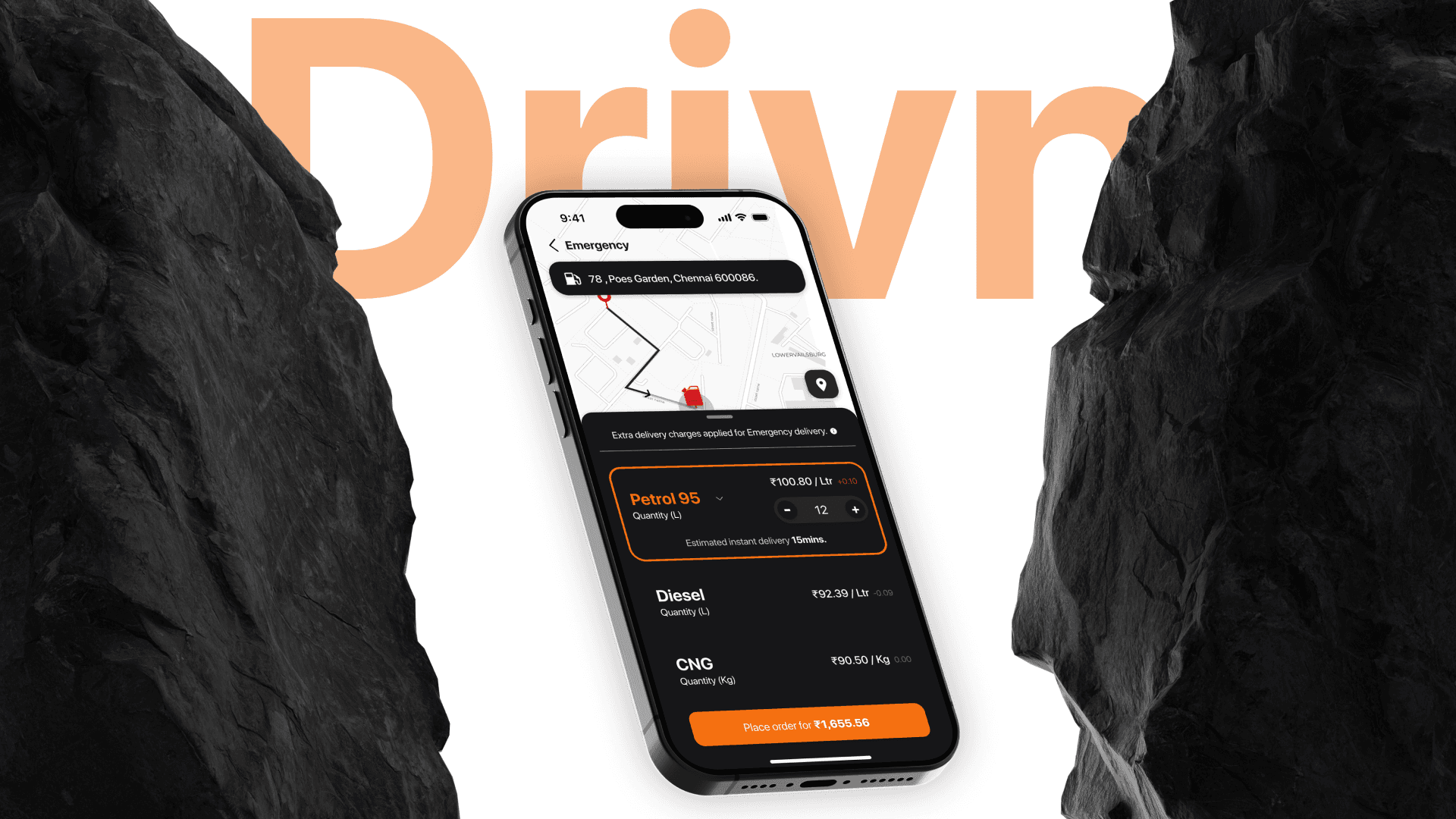
DRIVN is a fuel delivery app designed to solve a simple but frustrating problem: needing fuel when going to a petrol station is inconvenient, time-consuming, or not possible.
The idea was to bring fuel directly to the user’s vehicle, whether they are at home, at work, or stuck on the road. The app focuses on speed, clarity, and trust, turning a traditionally stressful situation into a predictable and controlled experience.
DRIVN covers the entire journey, from selecting fuel and quantity to live tracking, secure payment, and delivery confirmation, all with minimal user effort.
Categories
Energy & Utilities
Mobile App
Methods used
Problem Framing • Service Blueprint • User Journey Mapping • Task Flow Mapping • Interaction Design • Usability Testing
Date
Problem Statement
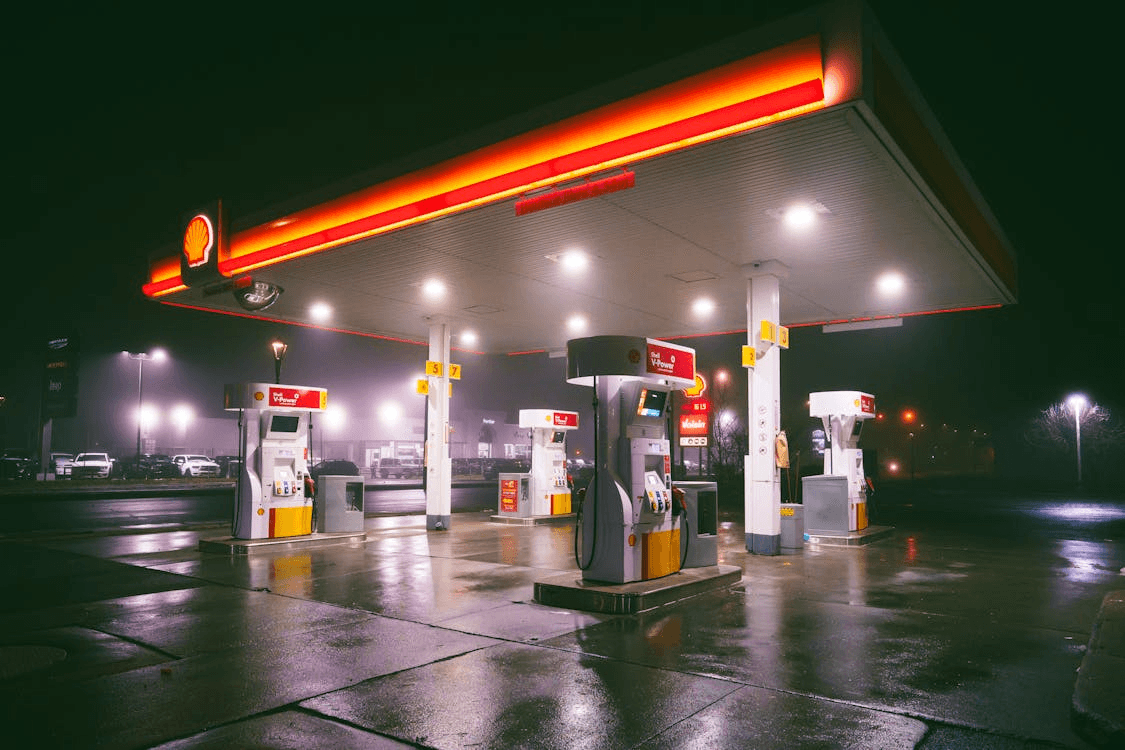
Refuelling a vehicle is still built around outdated assumptions. Users are expected to drive to fuel stations, wait in queues, and adjust their schedules around availability.
This becomes a bigger issue during emergencies, busy workdays, late nights, or when vehicles are immobile. Existing solutions do not address convenience, transparency, or real-time reassurance.
The challenge was to design a system that delivers fuel safely, clearly, and reliably while building enough trust for users to feel comfortable ordering something as critical as fuel.
Solution at a Glance
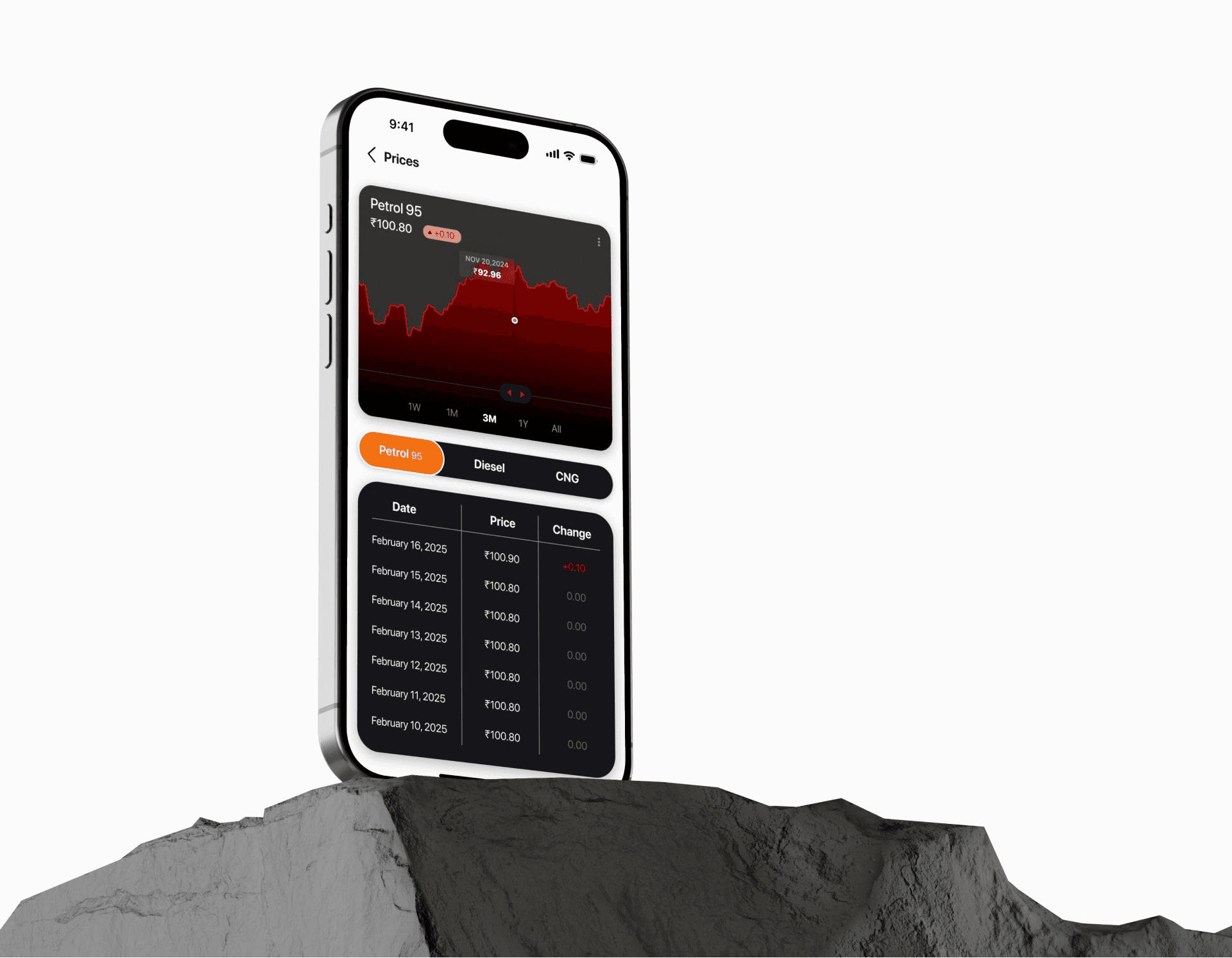
DRIVN allows users to order fuel to their vehicle in a few simple steps, track the delivery in real time, and complete secure in-app payments with full price transparency.
The experience combines convenience, visibility, and control, making fuel delivery feel predictable rather than risky.
How It Started
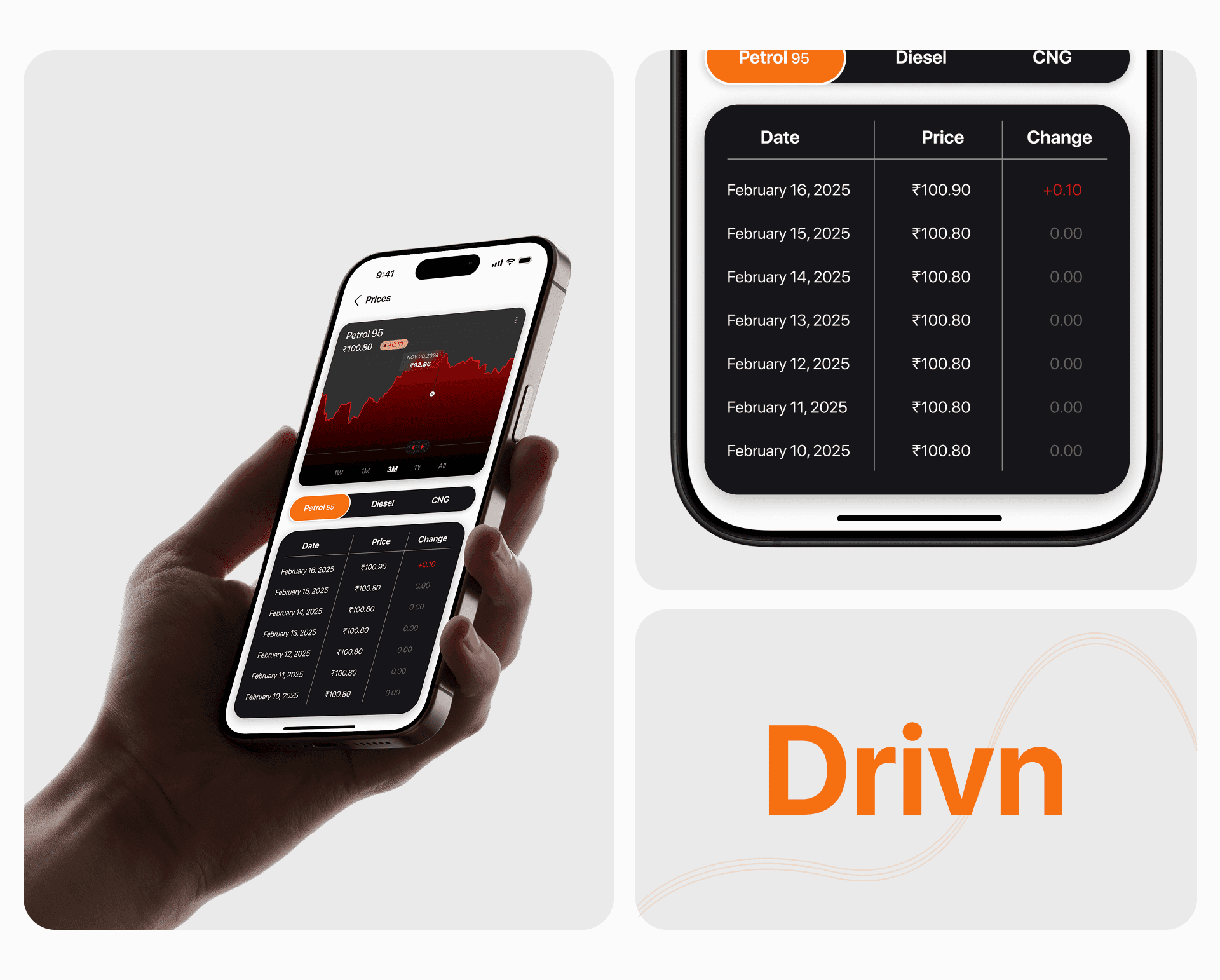
The idea for DRIVN came from observing everyday friction. People delaying refuelling, drivers running out of fuel unexpectedly, and the anxiety that comes with vehicle dependency.
Initial exploration focused on one question:
If food, groceries, and packages can be delivered, why not fuel?
From there, the project evolved into designing an experience that removes uncertainty. Users should always know what they are ordering, when it will arrive, and what it will cost, without having to think too much.
User Research
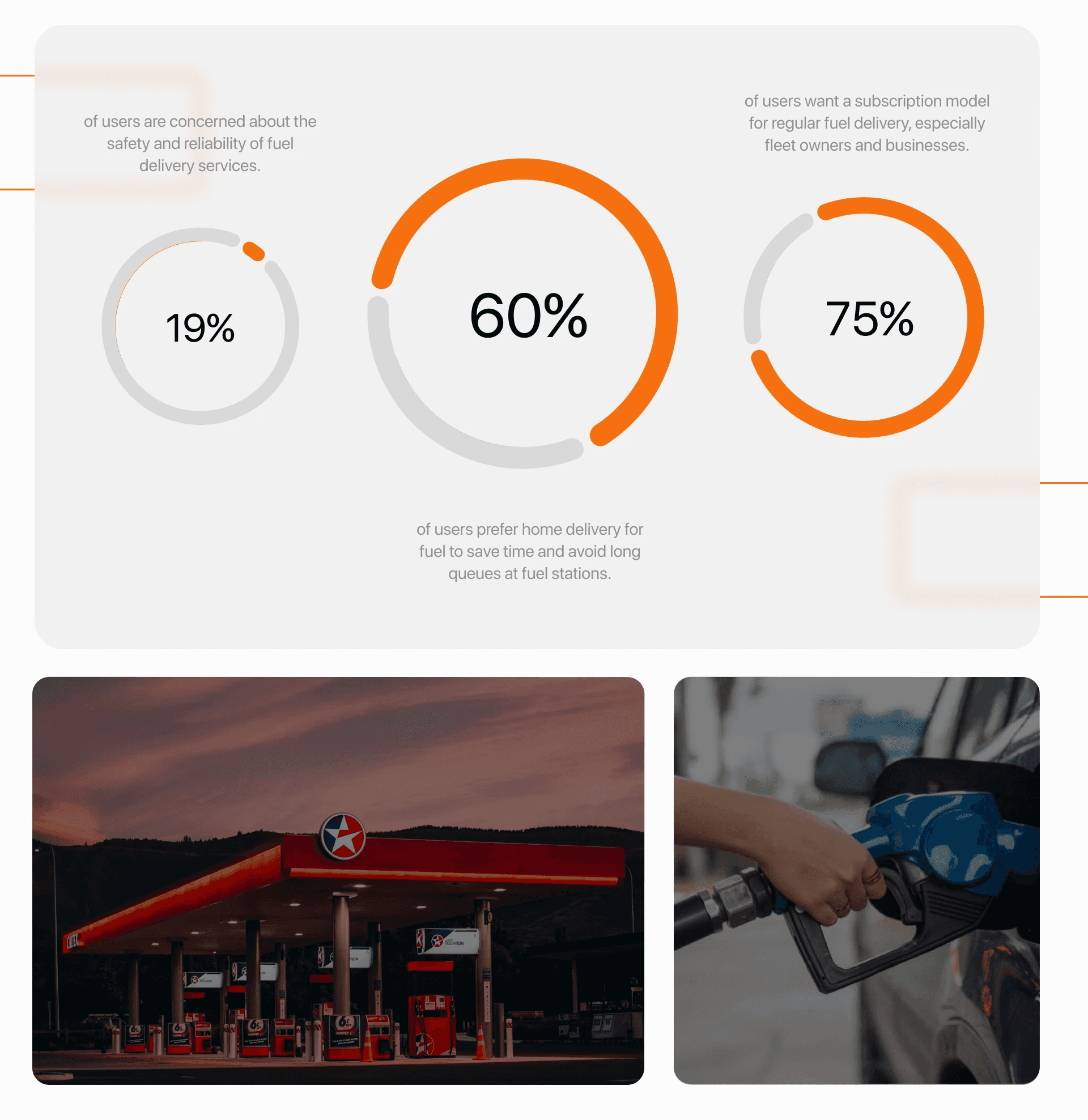
The research for DRIVN started with everyday conversations rather than formal studies.
I spoke to people who drive daily for work, long-distance commuters, delivery riders, and even friends and family who rely heavily on their vehicles. Instead of asking hypothetical questions, I focused on real situations. When was the last time they ran low on fuel? What did they do? How did it feel?
A clear pattern emerged. Most people do not plan refuelling. They delay it until it becomes urgent. Running out of fuel is rarely about forgetfulness alone. It usually happens during busy days, late nights, unexpected traffic, or emergencies where stopping at a fuel station feels like an added burden.
I also observed behaviour around refuelling stops. People worry about queues, pricing differences, and wasted time. In emergency situations, the stress increases sharply because the vehicle itself becomes the problem.
Another important insight was trust. While users liked the idea of fuel delivery, they were hesitant. Questions kept coming up.
Who is delivering the fuel?
Is the pricing fair?
How long will it take?
What if something goes wrong?
Approach
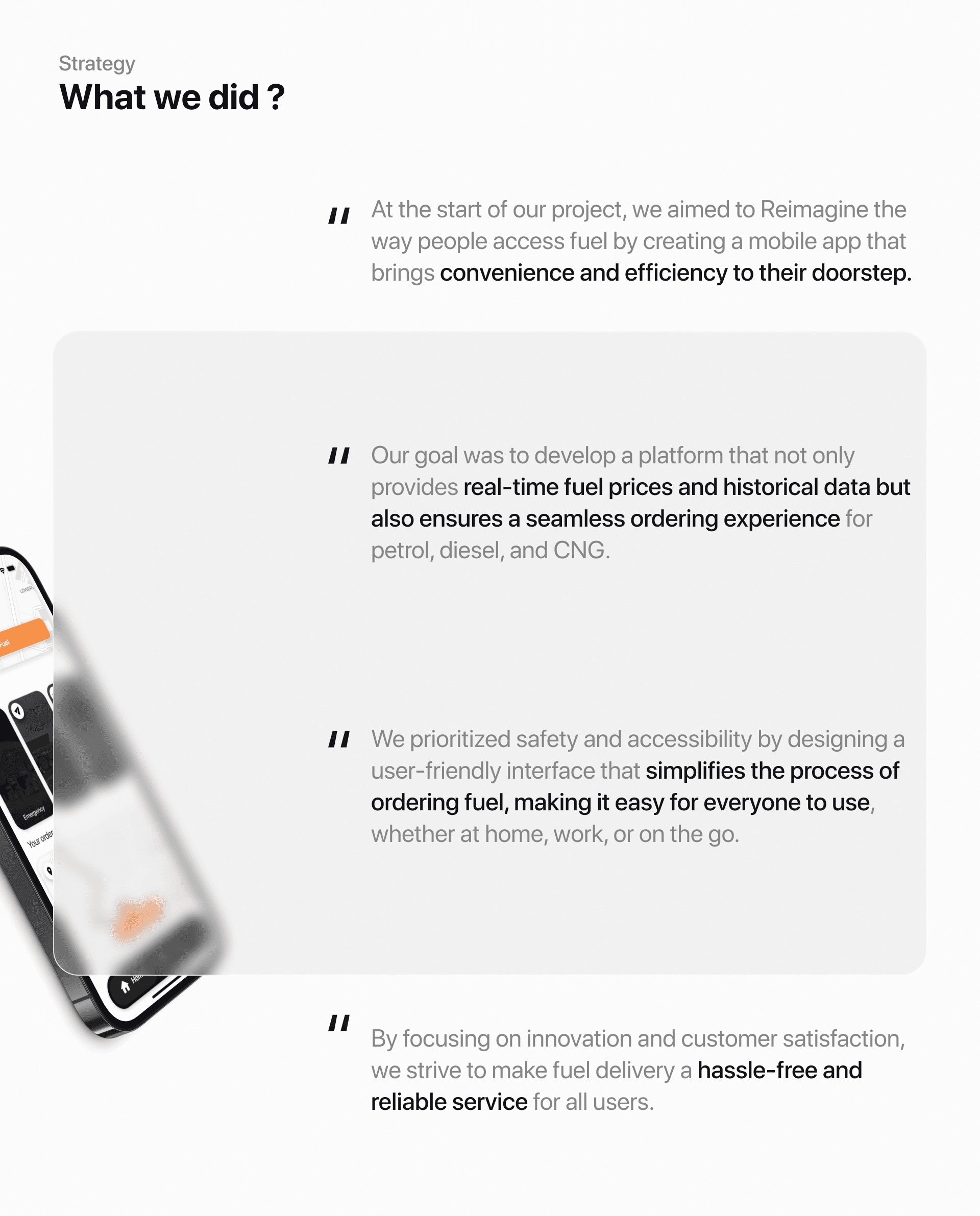
Once the research was clear, the approach almost designed itself.
People were not asking for more features. They were asking for certainty. In interviews, the hesitation was never about pressing a button. It was about what happens after pressing it.
So instead of designing DRIVN as a marketplace or a service catalogue, I treated it like a guided journey through uncertainty.
I started by mapping the emotional states users move through. Confusion when fuel runs low. Stress when time is tight. Doubt before confirming the order. Relief once help is on the way.
Every screen had to move the user forward emotionally, not just functionally.
I avoided overloading the experience with choices. Fuel type, quantity, and location are the only decisions users make. Everything else is handled by the system. Interviews showed that users trust services more when the app looks confident in its decisions.
Live visibility became a core part of the approach. Multiple users mentioned that “not knowing” was worse than waiting. So tracking, ETA, and order status were designed as reassurance tools, not just information.
The approach was simple. Reduce thinking. Reduce doubt. Reduce waiting without clarity.
Solution
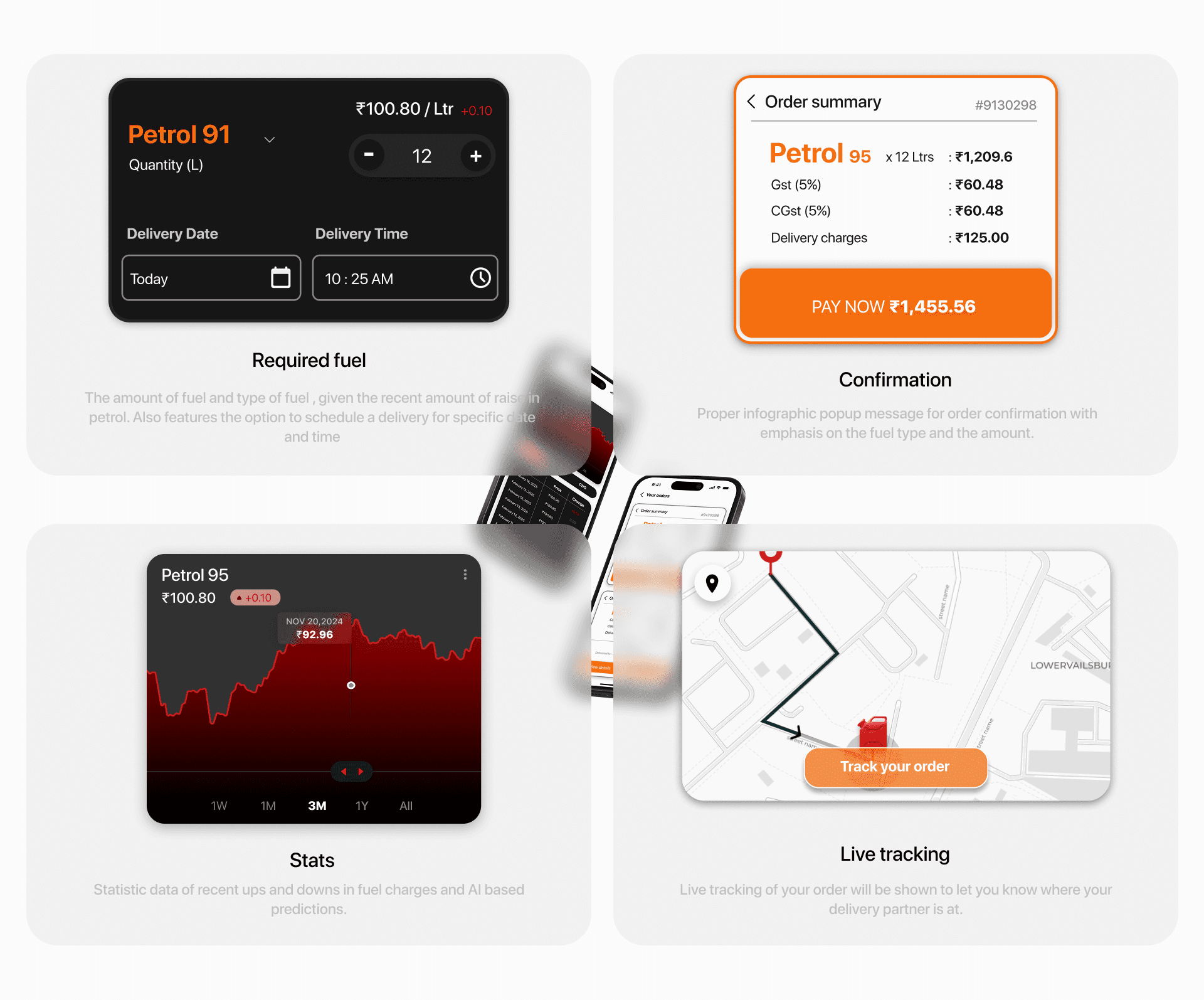
The experience begins with location and vehicle details. This immediately grounds the user in context. They are not browsing. They are solving a problem.
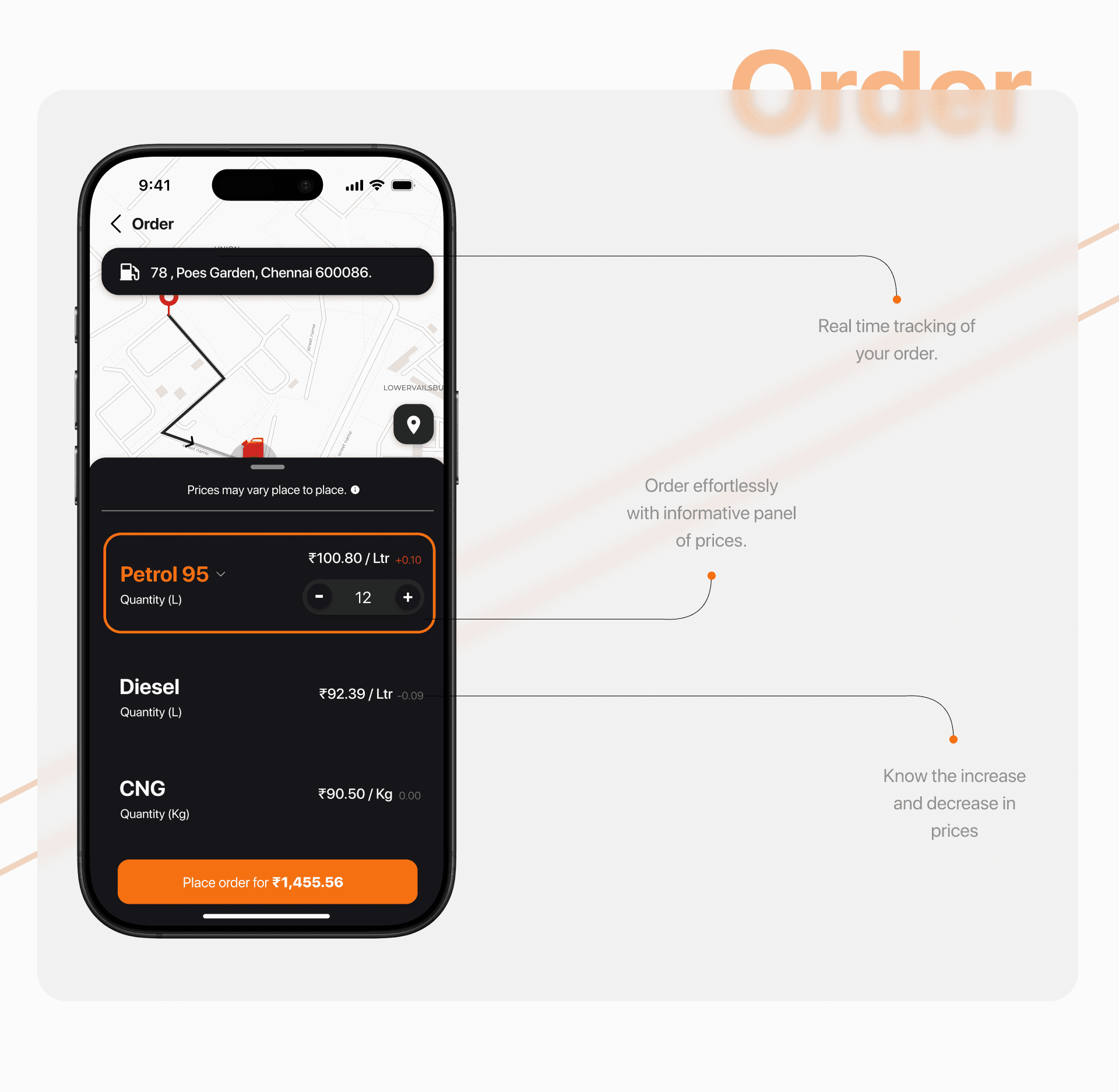
Fuel selection is straightforward. Type and quantity are presented clearly, with pricing visible upfront. No hidden charges. No surprises. This was a direct response to interview feedback where users said unexpected costs break trust instantly.
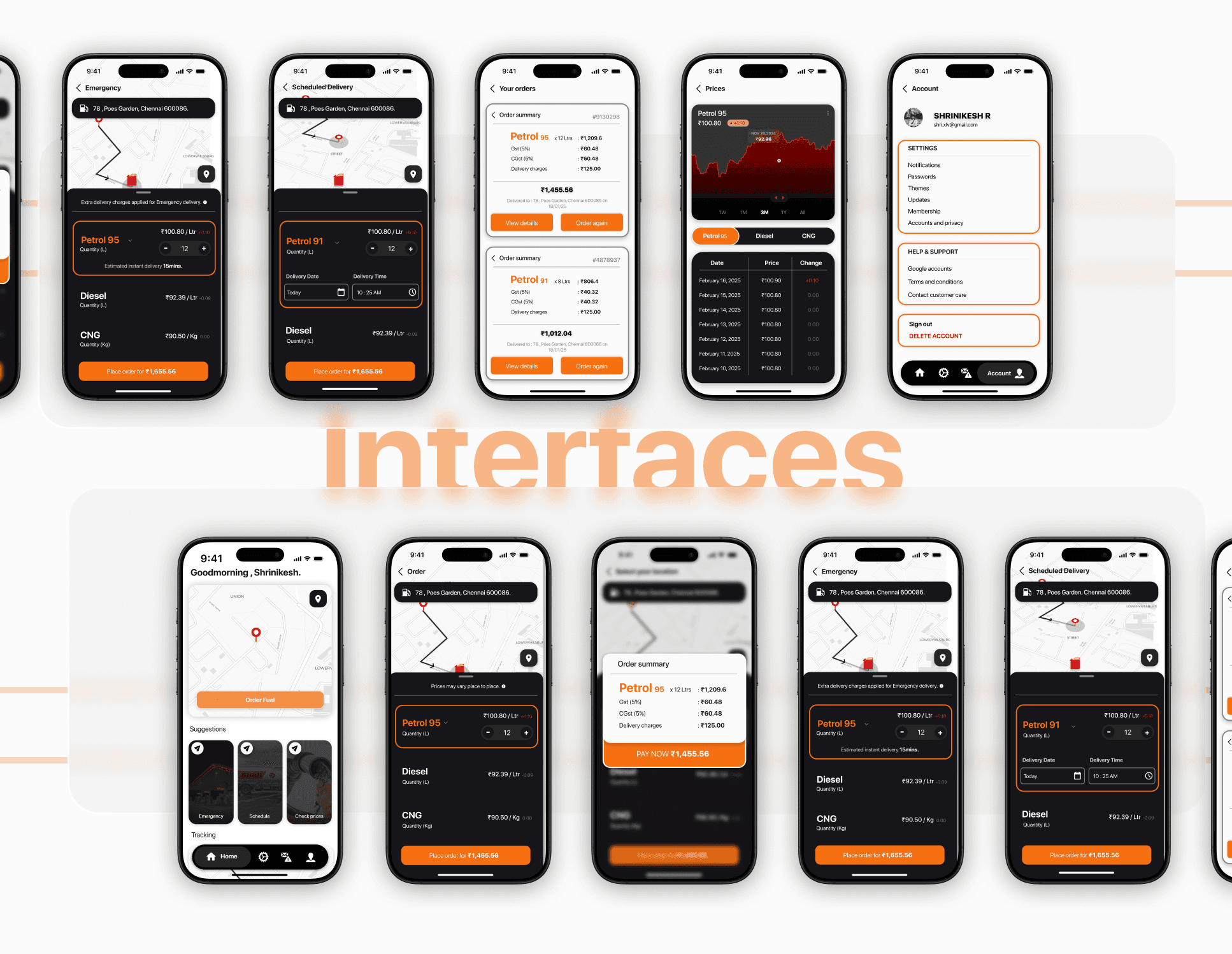
Once the order is placed, the app shifts focus from input to reassurance. Live tracking becomes the main screen. Users can see where the delivery vehicle is, how long it will take, and what stage the order is in.
Notifications support the flow but do not overwhelm it. Updates are purposeful and timed to reduce anxiety rather than create urgency.
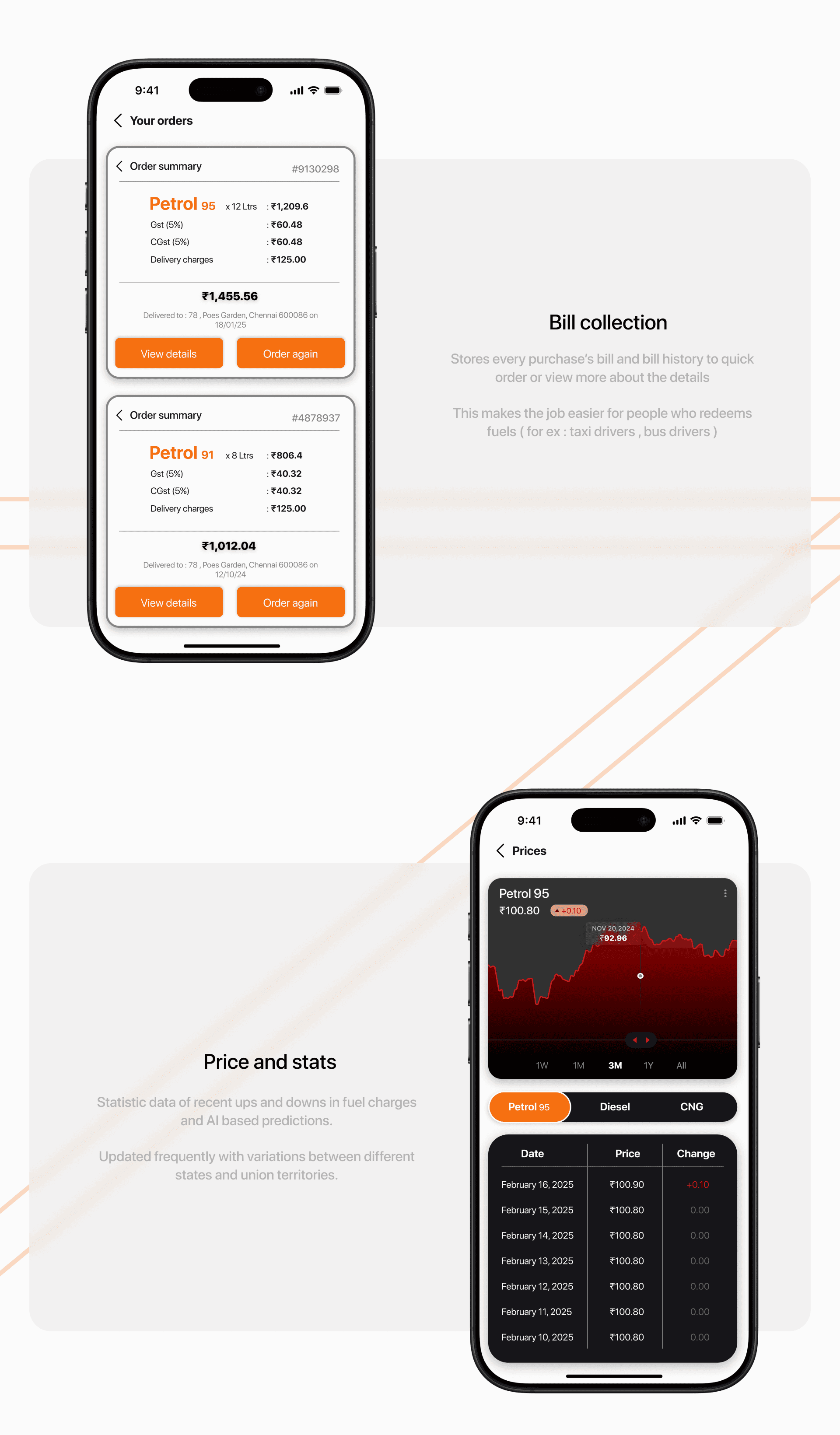
Payment happens inside the app, followed by a clear order summary. Users can access receipts and order history anytime, reinforcing reliability over repeat use.
Additional services like roadside assistance are positioned as support, not upsell. They exist for moments when users need help, not when the app wants attention.
Design Decisions
Several design decisions were shaped directly by interviews and observation.
The interface was designed to be readable at a glance. High contrast, clear typography, and strong hierarchy ensure users can understand what is happening even in stressful situations.
Maps and tracking visuals were kept simple. The goal was reassurance, not visual complexity.
Language was intentionally neutral and confident. No sales tone. No unnecessary friendliness. Users said they trust apps that sound sure of what they are doing.
The number of steps was kept minimal. Every additional tap was questioned. If it did not reduce uncertainty or move the user closer to fuel delivery, it was removed.
1.Readability
The interface was designed to be readable at a glance
2.Language & Tone
Language was intentionally neutral and confident. No sales tone.
3.Speed
The number of steps was kept minimal.
Key Insights
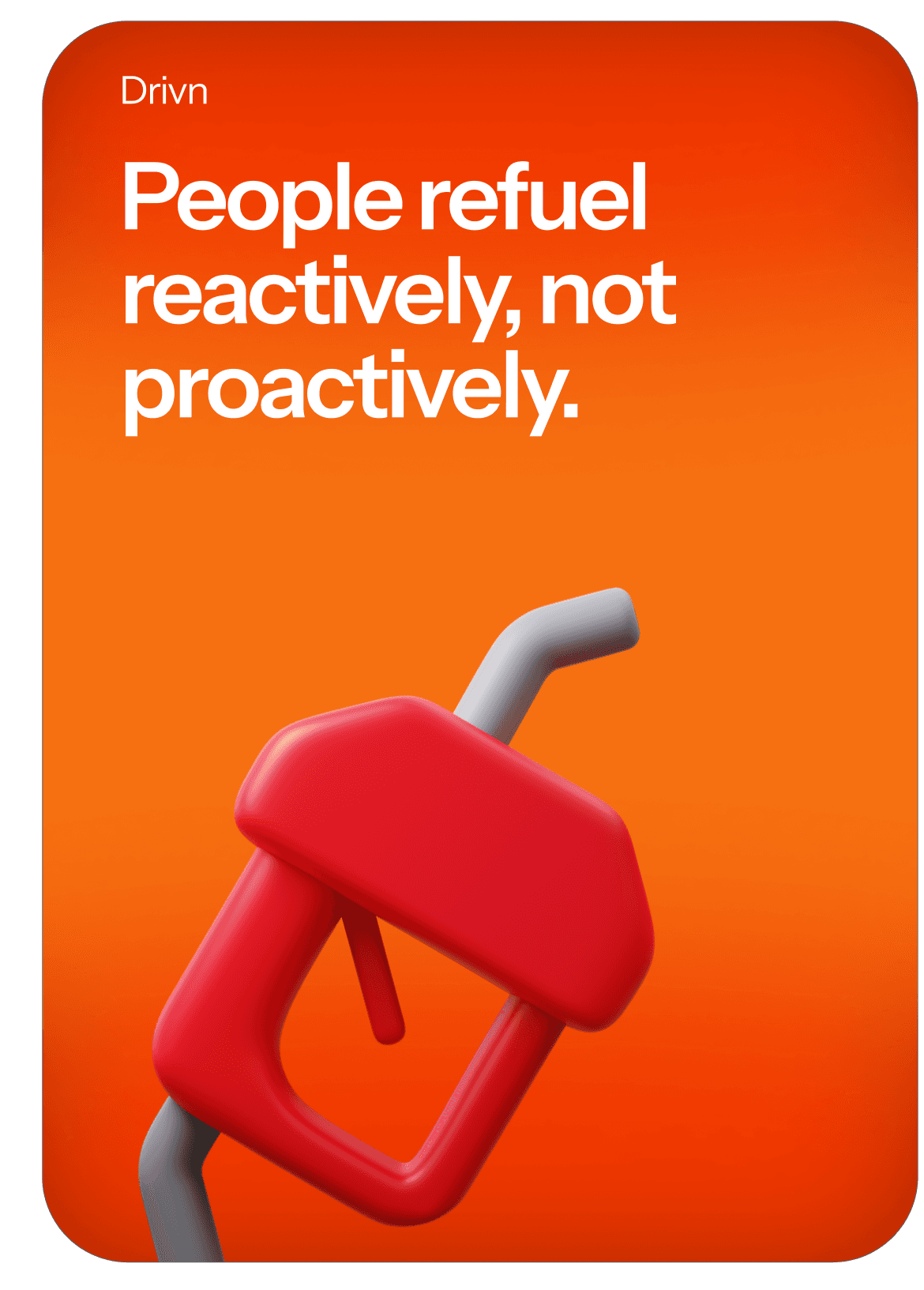
Most people do not plan refuelling ahead of time. It usually happens when fuel becomes a problem, not a task. This means the product has to work well under pressure, not just in calm situations.
Uncertainty causes more stress than delay. From interviews, users consistently said they were willing to wait longer if they knew exactly what was happening. Visibility and updates mattered more than speed alone.
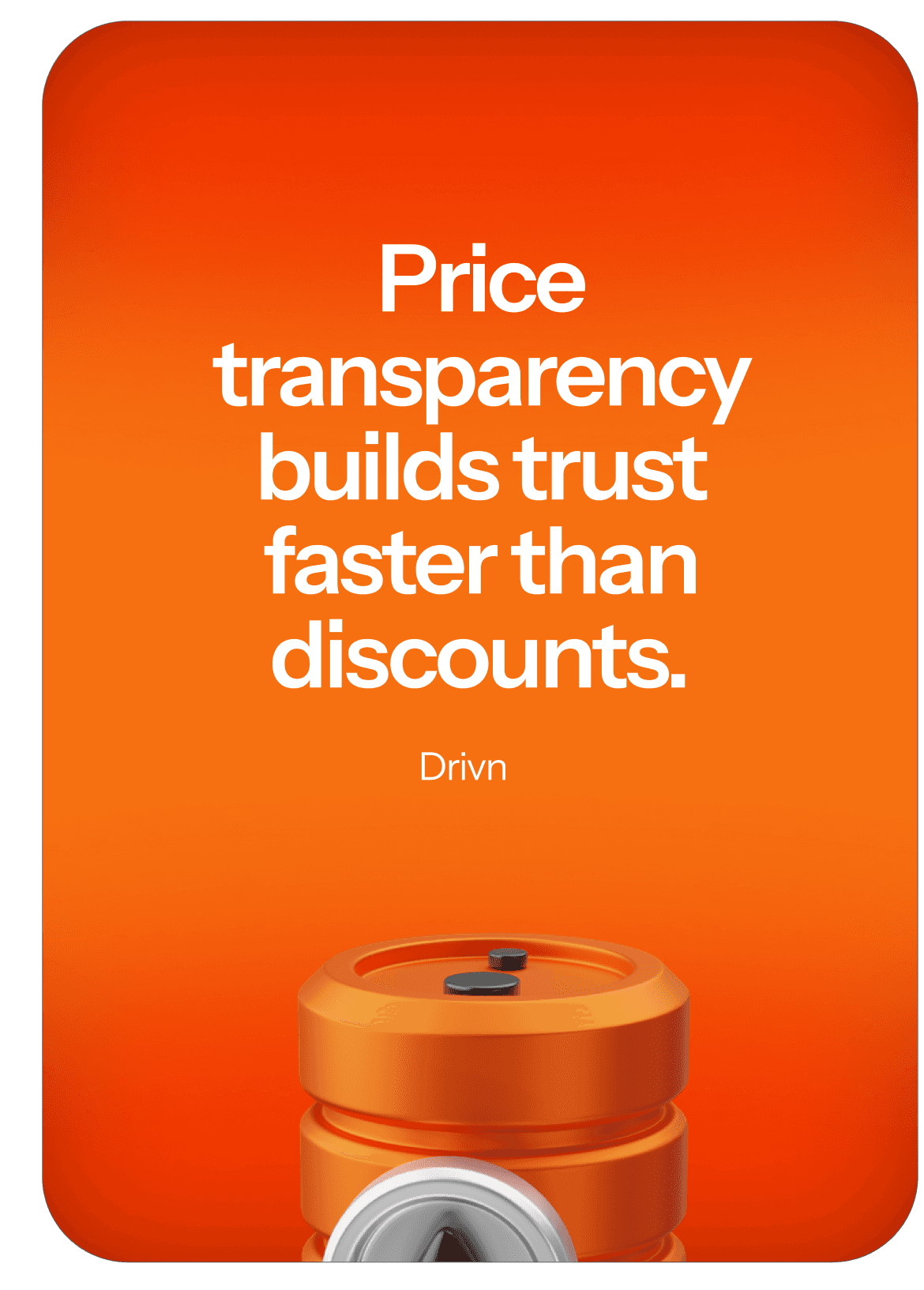
Price transparency directly affects trust. Users were comfortable paying for convenience, but unexpected charges immediately reduced confidence in the service.
Live tracking is not just a feature, it is reassurance. Seeing movement, progress, and ETA reduces anxiety and makes the service feel real and reliable.
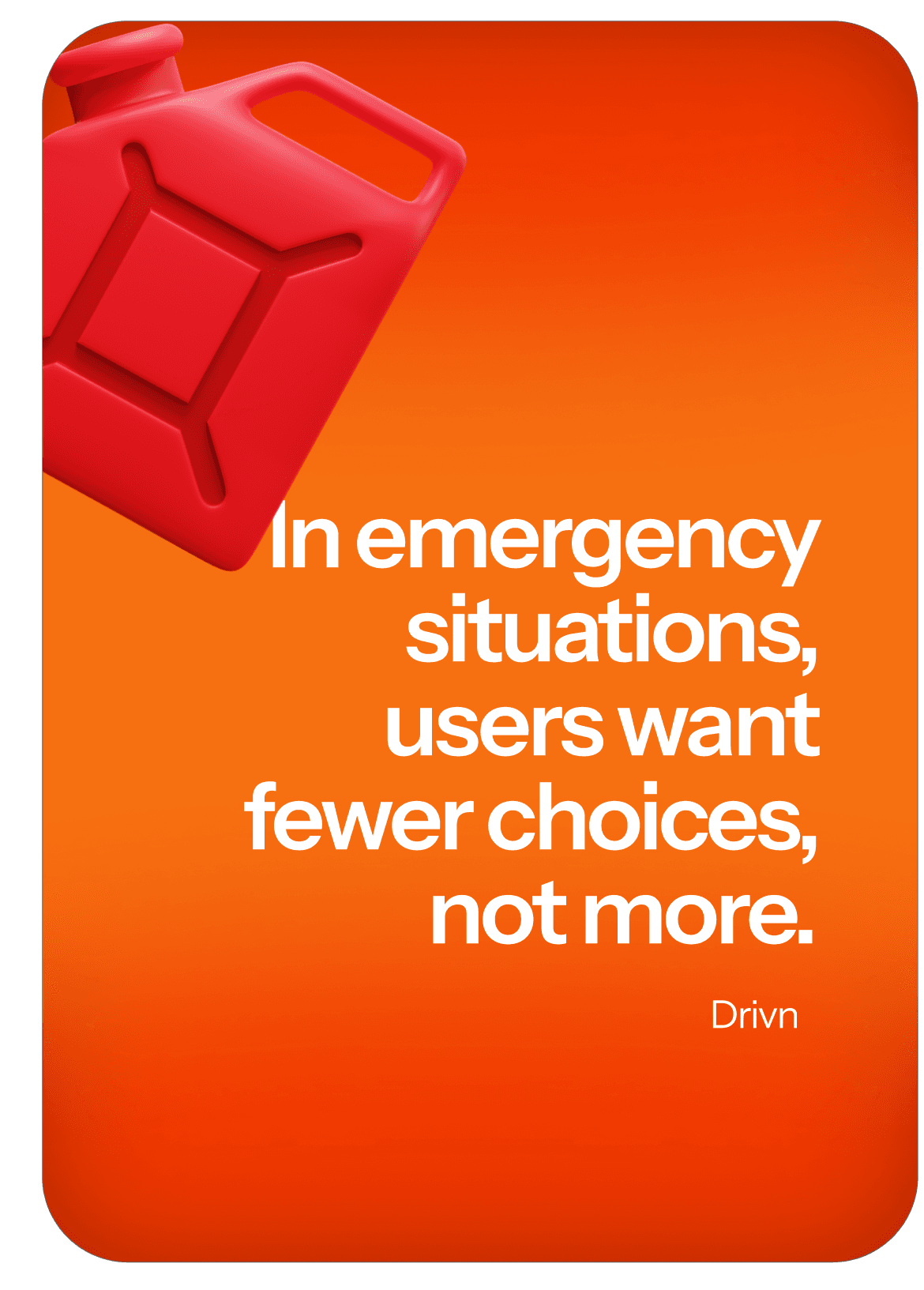
In emergency situations, users want fewer choices, not more. Clear defaults and confident system decisions helped users act faster and with less doubt.
Flow
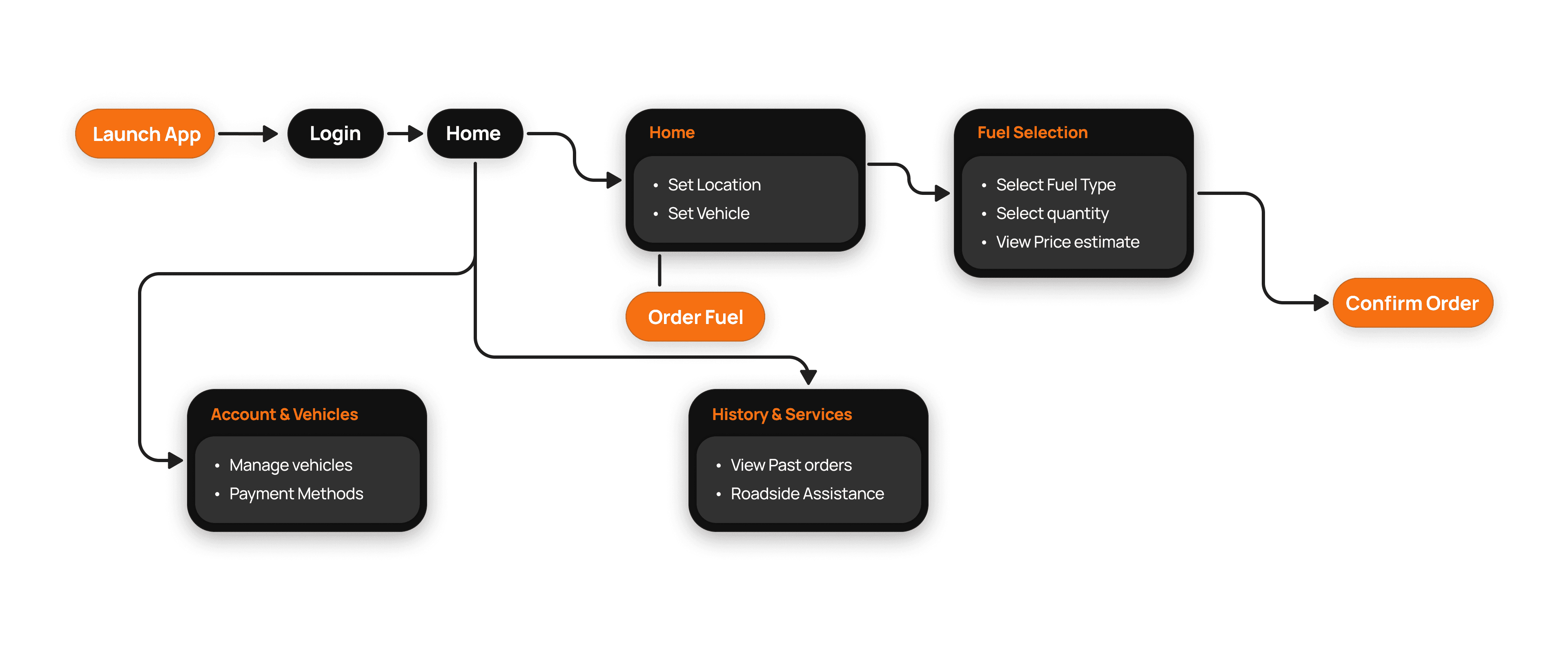
The primary flow moves from location selection to fuel choice, order confirmation, live tracking, payment, and delivery completion.
Secondary flows like account management, vehicle details, order history, and support exist quietly around the core journey. They never interrupt the main task.
Every flow was designed to feel predictable. Users should always know what happens next.
UI
Drivn
Overview
DRIVN is a fuel delivery app designed to solve a simple but frustrating problem: needing fuel when going to a petrol station is inconvenient, time-consuming, or not possible.
The idea was to bring fuel directly to the user’s vehicle, whether they are at home, at work, or stuck on the road. The app focuses on speed, clarity, and trust, turning a traditionally stressful situation into a predictable and controlled experience.
DRIVN covers the entire journey, from selecting fuel and quantity to live tracking, secure payment, and delivery confirmation, all with minimal user effort.
Categories
Energy & Utilities
Mobile App
Methods used
Problem Framing • Service Blueprint • User Journey Mapping • Task Flow Mapping • Interaction Design • Usability Testing
Date
Problem Statement
Refuelling a vehicle is still built around outdated assumptions. Users are expected to drive to fuel stations, wait in queues, and adjust their schedules around availability.
This becomes a bigger issue during emergencies, busy workdays, late nights, or when vehicles are immobile. Existing solutions do not address convenience, transparency, or real-time reassurance.
The challenge was to design a system that delivers fuel safely, clearly, and reliably while building enough trust for users to feel comfortable ordering something as critical as fuel.
Solution at a Glance
DRIVN allows users to order fuel to their vehicle in a few simple steps, track the delivery in real time, and complete secure in-app payments with full price transparency.
The experience combines convenience, visibility, and control, making fuel delivery feel predictable rather than risky.
How It Started
The idea for DRIVN came from observing everyday friction. People delaying refuelling, drivers running out of fuel unexpectedly, and the anxiety that comes with vehicle dependency.
Initial exploration focused on one question:
If food, groceries, and packages can be delivered, why not fuel?
From there, the project evolved into designing an experience that removes uncertainty. Users should always know what they are ordering, when it will arrive, and what it will cost, without having to think too much.
User Research
The research for DRIVN started with everyday conversations rather than formal studies.
I spoke to people who drive daily for work, long-distance commuters, delivery riders, and even friends and family who rely heavily on their vehicles. Instead of asking hypothetical questions, I focused on real situations. When was the last time they ran low on fuel? What did they do? How did it feel?
A clear pattern emerged. Most people do not plan refuelling. They delay it until it becomes urgent. Running out of fuel is rarely about forgetfulness alone. It usually happens during busy days, late nights, unexpected traffic, or emergencies where stopping at a fuel station feels like an added burden.
I also observed behaviour around refuelling stops. People worry about queues, pricing differences, and wasted time. In emergency situations, the stress increases sharply because the vehicle itself becomes the problem.
Another important insight was trust. While users liked the idea of fuel delivery, they were hesitant. Questions kept coming up.
Who is delivering the fuel?
Is the pricing fair?
How long will it take?
What if something goes wrong?
Approach
Once the research was clear, the approach almost designed itself.
People were not asking for more features. They were asking for certainty. In interviews, the hesitation was never about pressing a button. It was about what happens after pressing it.
So instead of designing DRIVN as a marketplace or a service catalogue, I treated it like a guided journey through uncertainty.
I started by mapping the emotional states users move through. Confusion when fuel runs low. Stress when time is tight. Doubt before confirming the order. Relief once help is on the way.
Every screen had to move the user forward emotionally, not just functionally.
I avoided overloading the experience with choices. Fuel type, quantity, and location are the only decisions users make. Everything else is handled by the system. Interviews showed that users trust services more when the app looks confident in its decisions.
Live visibility became a core part of the approach. Multiple users mentioned that “not knowing” was worse than waiting. So tracking, ETA, and order status were designed as reassurance tools, not just information.
The approach was simple. Reduce thinking. Reduce doubt. Reduce waiting without clarity.
Solution
The experience begins with location and vehicle details. This immediately grounds the user in context. They are not browsing. They are solving a problem.
Fuel selection is straightforward. Type and quantity are presented clearly, with pricing visible upfront. No hidden charges. No surprises. This was a direct response to interview feedback where users said unexpected costs break trust instantly.
Once the order is placed, the app shifts focus from input to reassurance. Live tracking becomes the main screen. Users can see where the delivery vehicle is, how long it will take, and what stage the order is in.
Notifications support the flow but do not overwhelm it. Updates are purposeful and timed to reduce anxiety rather than create urgency.
Payment happens inside the app, followed by a clear order summary. Users can access receipts and order history anytime, reinforcing reliability over repeat use.
Additional services like roadside assistance are positioned as support, not upsell. They exist for moments when users need help, not when the app wants attention.
Design Decisions
Several design decisions were shaped directly by interviews and observation.
The interface was designed to be readable at a glance. High contrast, clear typography, and strong hierarchy ensure users can understand what is happening even in stressful situations.
Maps and tracking visuals were kept simple. The goal was reassurance, not visual complexity.
Language was intentionally neutral and confident. No sales tone. No unnecessary friendliness. Users said they trust apps that sound sure of what they are doing.
The number of steps was kept minimal. Every additional tap was questioned. If it did not reduce uncertainty or move the user closer to fuel delivery, it was removed.
1.Readability
The interface was designed to be readable at a glance
2.Language & Tone
Language was intentionally neutral and confident. No sales tone.
3.Speed
The number of steps was kept minimal.
Key Insights
Most people do not plan refuelling ahead of time. It usually happens when fuel becomes a problem, not a task. This means the product has to work well under pressure, not just in calm situations.
Uncertainty causes more stress than delay. From interviews, users consistently said they were willing to wait longer if they knew exactly what was happening. Visibility and updates mattered more than speed alone.
Price transparency directly affects trust. Users were comfortable paying for convenience, but unexpected charges immediately reduced confidence in the service.
Live tracking is not just a feature, it is reassurance. Seeing movement, progress, and ETA reduces anxiety and makes the service feel real and reliable.
In emergency situations, users want fewer choices, not more. Clear defaults and confident system decisions helped users act faster and with less doubt.
Flow
The primary flow moves from location selection to fuel choice, order confirmation, live tracking, payment, and delivery completion.
Secondary flows like account management, vehicle details, order history, and support exist quietly around the core journey. They never interrupt the main task.
Every flow was designed to feel predictable. Users should always know what happens next.
UI
Drivn
Overview
DRIVN is a fuel delivery app designed to solve a simple but frustrating problem: needing fuel when going to a petrol station is inconvenient, time-consuming, or not possible.
The idea was to bring fuel directly to the user’s vehicle, whether they are at home, at work, or stuck on the road. The app focuses on speed, clarity, and trust, turning a traditionally stressful situation into a predictable and controlled experience.
DRIVN covers the entire journey, from selecting fuel and quantity to live tracking, secure payment, and delivery confirmation, all with minimal user effort.
Categories
Energy & Utilities
Mobile App
Methods used
Problem Framing • Service Blueprint • User Journey Mapping • Task Flow Mapping • Interaction Design • Usability Testing
Date
Problem Statement
Refuelling a vehicle is still built around outdated assumptions. Users are expected to drive to fuel stations, wait in queues, and adjust their schedules around availability.
This becomes a bigger issue during emergencies, busy workdays, late nights, or when vehicles are immobile. Existing solutions do not address convenience, transparency, or real-time reassurance.
The challenge was to design a system that delivers fuel safely, clearly, and reliably while building enough trust for users to feel comfortable ordering something as critical as fuel.
Solution at a Glance
DRIVN allows users to order fuel to their vehicle in a few simple steps, track the delivery in real time, and complete secure in-app payments with full price transparency.
The experience combines convenience, visibility, and control, making fuel delivery feel predictable rather than risky.
How It Started
The idea for DRIVN came from observing everyday friction. People delaying refuelling, drivers running out of fuel unexpectedly, and the anxiety that comes with vehicle dependency.
Initial exploration focused on one question:
If food, groceries, and packages can be delivered, why not fuel?
From there, the project evolved into designing an experience that removes uncertainty. Users should always know what they are ordering, when it will arrive, and what it will cost, without having to think too much.
User Research
The research for DRIVN started with everyday conversations rather than formal studies.
I spoke to people who drive daily for work, long-distance commuters, delivery riders, and even friends and family who rely heavily on their vehicles. Instead of asking hypothetical questions, I focused on real situations. When was the last time they ran low on fuel? What did they do? How did it feel?
A clear pattern emerged. Most people do not plan refuelling. They delay it until it becomes urgent. Running out of fuel is rarely about forgetfulness alone. It usually happens during busy days, late nights, unexpected traffic, or emergencies where stopping at a fuel station feels like an added burden.
I also observed behaviour around refuelling stops. People worry about queues, pricing differences, and wasted time. In emergency situations, the stress increases sharply because the vehicle itself becomes the problem.
Another important insight was trust. While users liked the idea of fuel delivery, they were hesitant. Questions kept coming up.
Who is delivering the fuel?
Is the pricing fair?
How long will it take?
What if something goes wrong?
Approach
Once the research was clear, the approach almost designed itself.
People were not asking for more features. They were asking for certainty. In interviews, the hesitation was never about pressing a button. It was about what happens after pressing it.
So instead of designing DRIVN as a marketplace or a service catalogue, I treated it like a guided journey through uncertainty.
I started by mapping the emotional states users move through. Confusion when fuel runs low. Stress when time is tight. Doubt before confirming the order. Relief once help is on the way.
Every screen had to move the user forward emotionally, not just functionally.
I avoided overloading the experience with choices. Fuel type, quantity, and location are the only decisions users make. Everything else is handled by the system. Interviews showed that users trust services more when the app looks confident in its decisions.
Live visibility became a core part of the approach. Multiple users mentioned that “not knowing” was worse than waiting. So tracking, ETA, and order status were designed as reassurance tools, not just information.
The approach was simple. Reduce thinking. Reduce doubt. Reduce waiting without clarity.
Solution
The experience begins with location and vehicle details. This immediately grounds the user in context. They are not browsing. They are solving a problem.
Fuel selection is straightforward. Type and quantity are presented clearly, with pricing visible upfront. No hidden charges. No surprises. This was a direct response to interview feedback where users said unexpected costs break trust instantly.
Once the order is placed, the app shifts focus from input to reassurance. Live tracking becomes the main screen. Users can see where the delivery vehicle is, how long it will take, and what stage the order is in.
Notifications support the flow but do not overwhelm it. Updates are purposeful and timed to reduce anxiety rather than create urgency.
Payment happens inside the app, followed by a clear order summary. Users can access receipts and order history anytime, reinforcing reliability over repeat use.
Additional services like roadside assistance are positioned as support, not upsell. They exist for moments when users need help, not when the app wants attention.
Design Decisions
Several design decisions were shaped directly by interviews and observation.
The interface was designed to be readable at a glance. High contrast, clear typography, and strong hierarchy ensure users can understand what is happening even in stressful situations.
Maps and tracking visuals were kept simple. The goal was reassurance, not visual complexity.
Language was intentionally neutral and confident. No sales tone. No unnecessary friendliness. Users said they trust apps that sound sure of what they are doing.
The number of steps was kept minimal. Every additional tap was questioned. If it did not reduce uncertainty or move the user closer to fuel delivery, it was removed.
1.Readability
The interface was designed to be readable at a glance
2.Language & Tone
Language was intentionally neutral and confident. No sales tone.
3.Speed
The number of steps was kept minimal.
Key Insights
Most people do not plan refuelling ahead of time. It usually happens when fuel becomes a problem, not a task. This means the product has to work well under pressure, not just in calm situations.
Uncertainty causes more stress than delay. From interviews, users consistently said they were willing to wait longer if they knew exactly what was happening. Visibility and updates mattered more than speed alone.
Price transparency directly affects trust. Users were comfortable paying for convenience, but unexpected charges immediately reduced confidence in the service.
Live tracking is not just a feature, it is reassurance. Seeing movement, progress, and ETA reduces anxiety and makes the service feel real and reliable.
In emergency situations, users want fewer choices, not more. Clear defaults and confident system decisions helped users act faster and with less doubt.
Flow
The primary flow moves from location selection to fuel choice, order confirmation, live tracking, payment, and delivery completion.
Secondary flows like account management, vehicle details, order history, and support exist quietly around the core journey. They never interrupt the main task.
Every flow was designed to feel predictable. Users should always know what happens next.
UI