NOTHING POWER 1
Overview
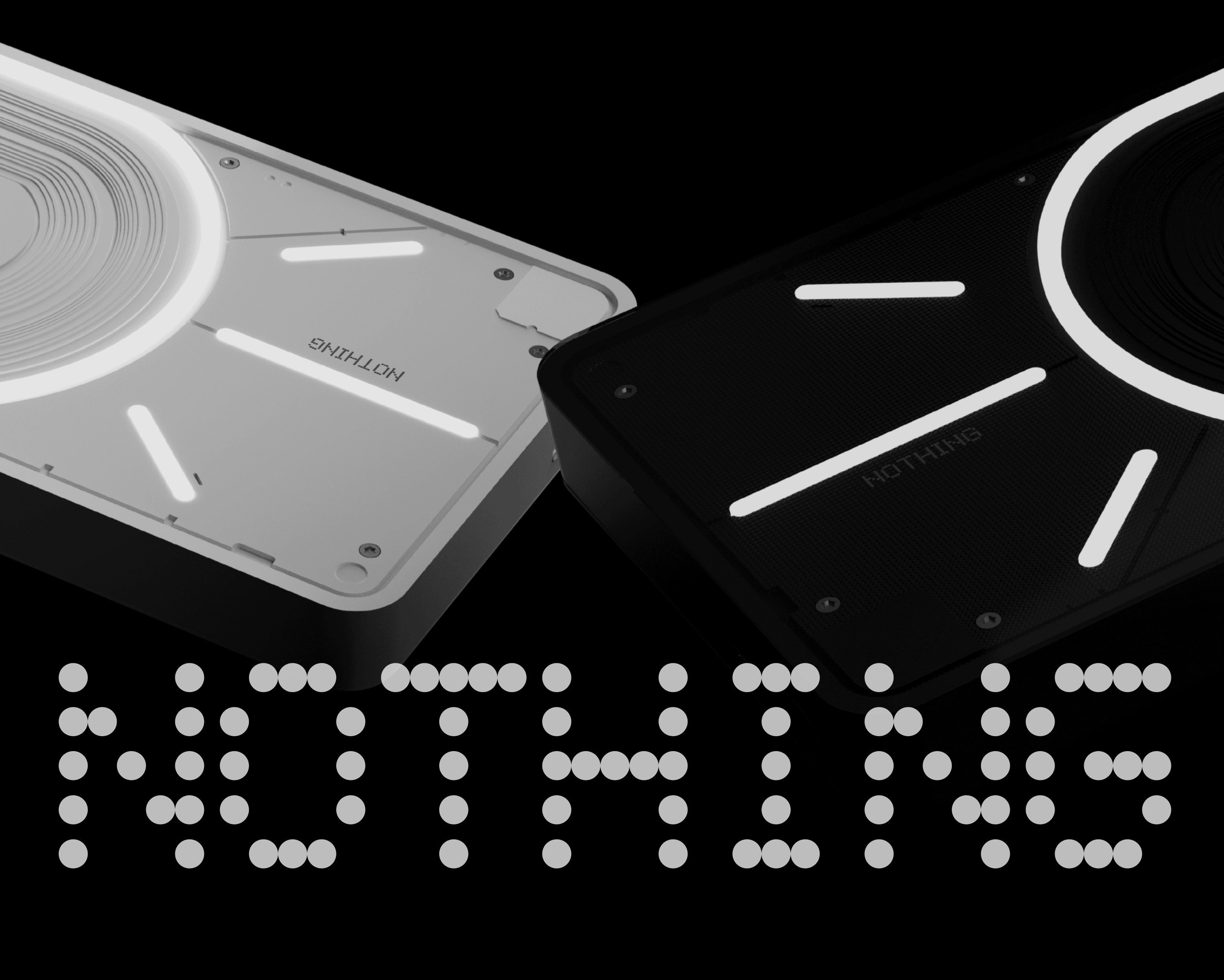
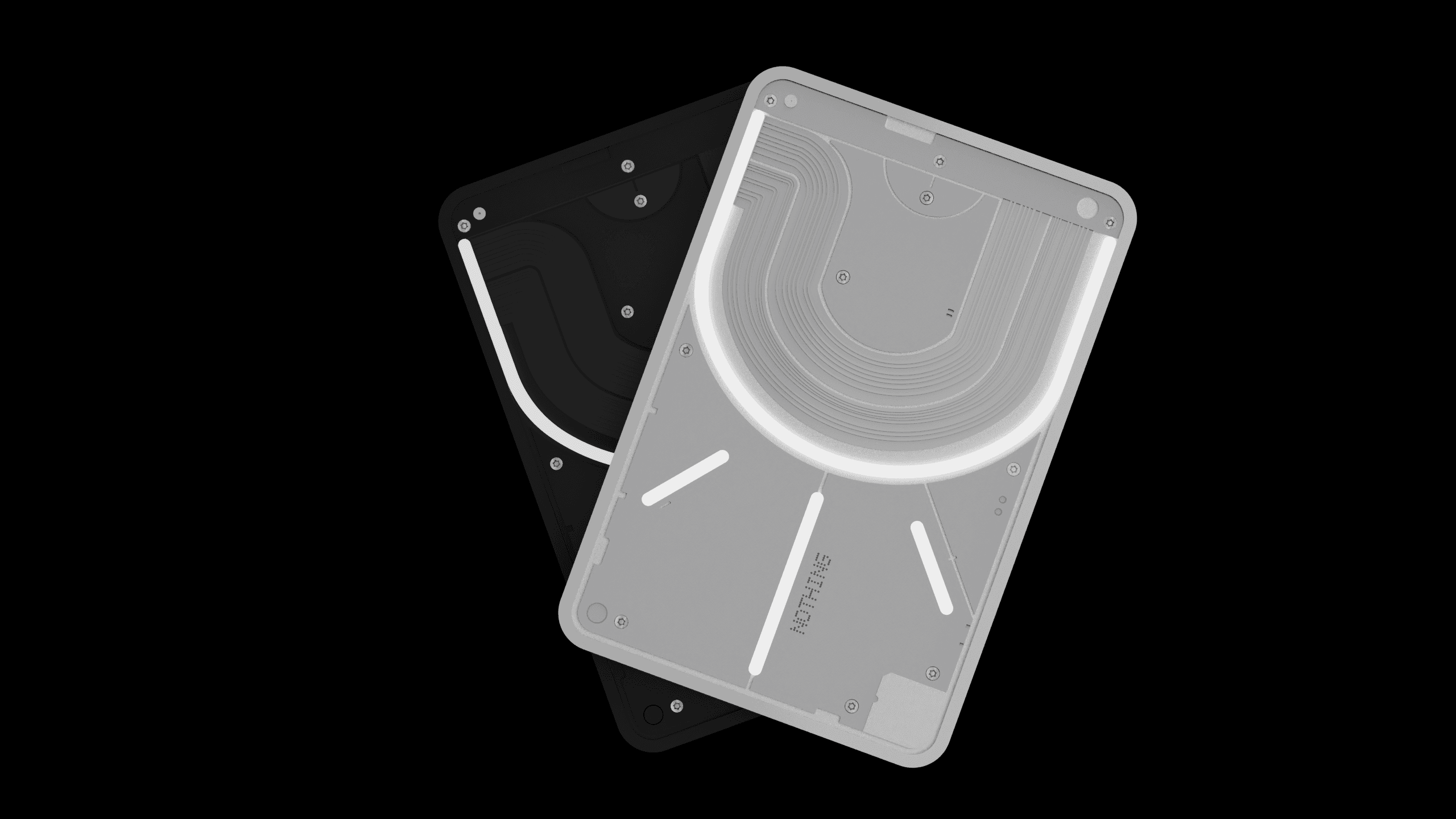
NOTHING Power (1) is a conceptual power bank designed as an extension of the Nothing ecosystem rather than a standalone accessory.
The project explores how a highly utilitarian object can become expressive, communicative, and emotionally engaging without relying on screens or excessive controls.
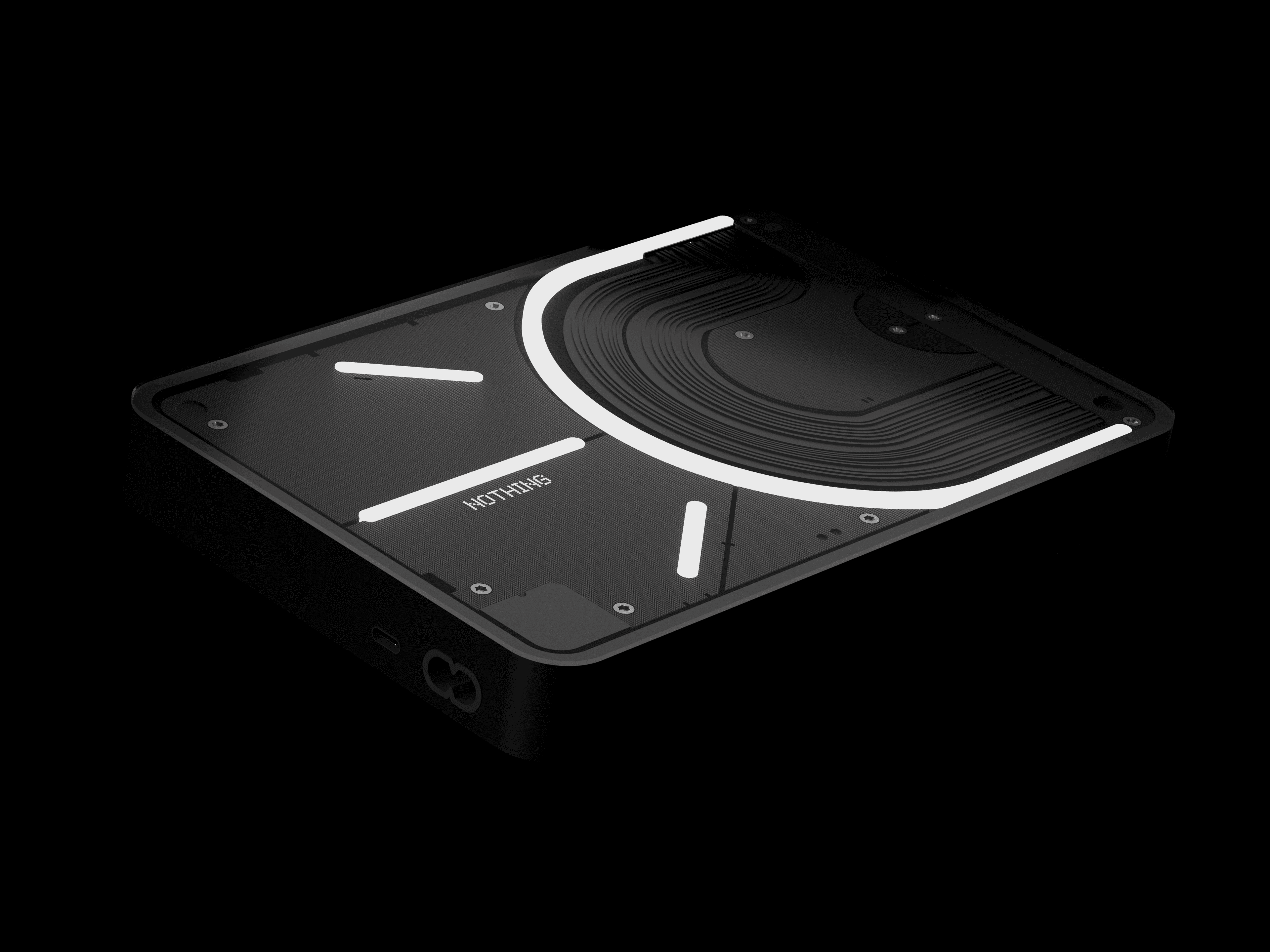
By integrating Nothing’s signature Glyph lighting system, the power bank becomes an active object that mirrors notifications, charging states, and system feedback from the connected phone. The result is a product that feels alive, responsive, and visually distinct while staying minimal and purposeful.
This project focuses on form, material, light interaction, and ecosystem thinking through an industrial design lens.
Categories
Consumer Electronics
POWERBANK
Methods used
User Observation • Ergonomic Analysis • Functional Deconstruction • Form Exploration • CAD Modeling • Prototype Development
Date
Problem Statement
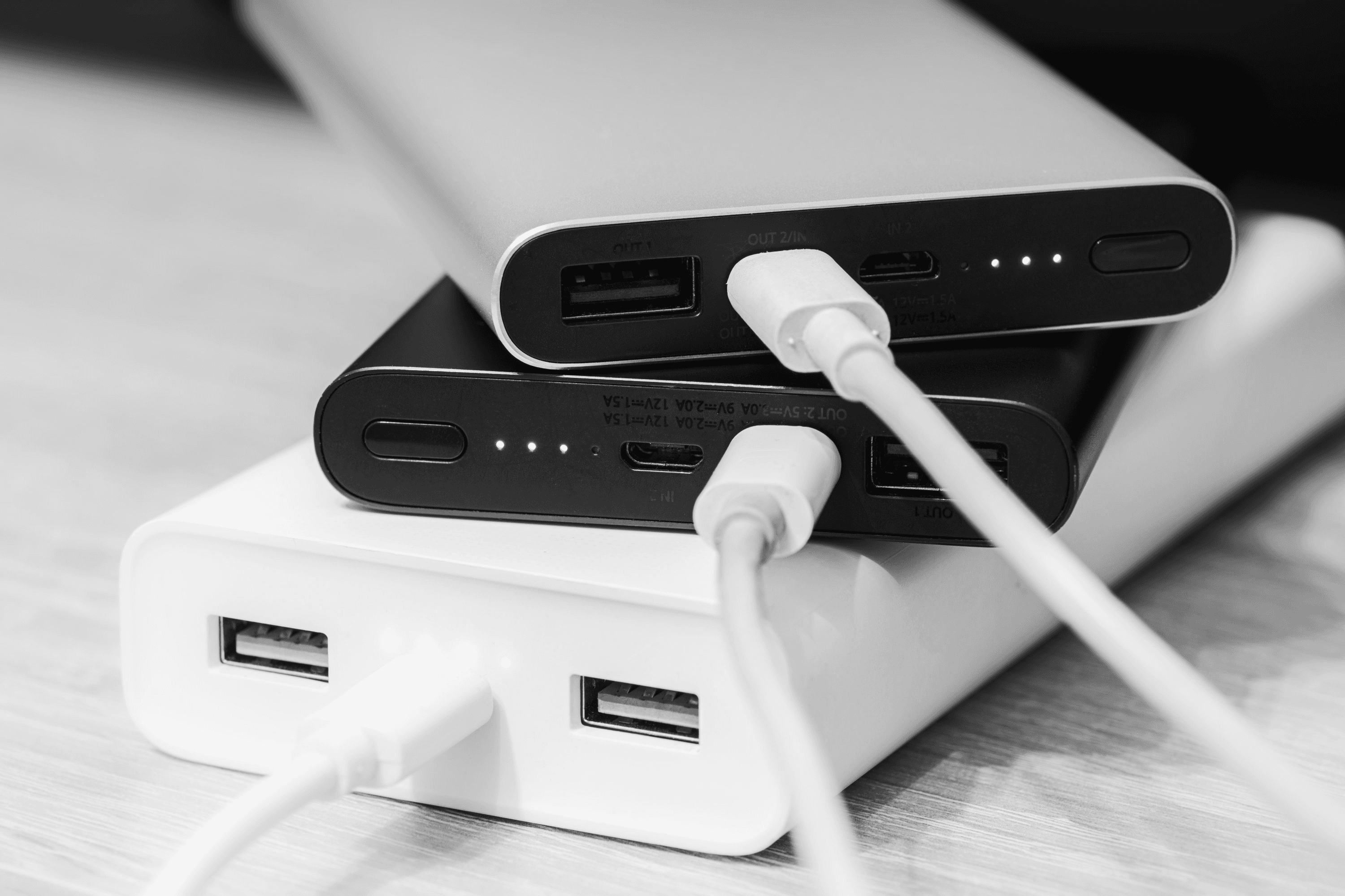
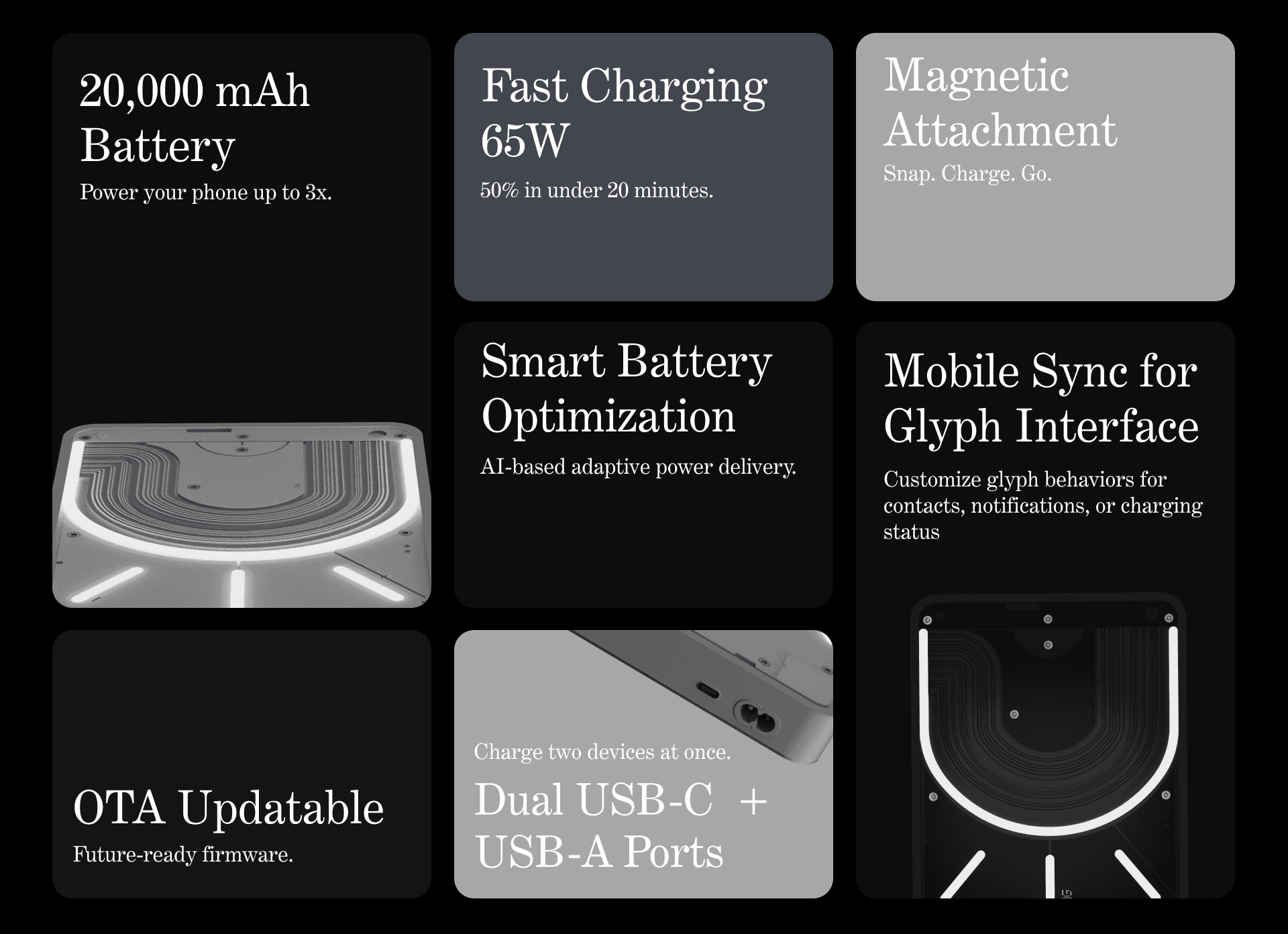
Power banks today are largely generic objects.
Most differ only in capacity and size, offering little thought to identity, interaction, or emotional connection.
Common issues observed:
Boxy, forgettable forms
Minimal feedback limited to small LED dots
No connection to the phone’s interaction language
Treated as accessories rather than designed products
The challenge was to redesign a power bank that feels intentional, expressive, and integrated into a larger product ecosystem while remaining realistic and functional.
Solution at a Glance

NOTHING Power (1) reimagines the power bank as a communicative object.
Instead of hiding interaction behind screens or buttons, the product uses Glyph lighting to visually convey notifications, charging status, and power information. The physical form, materials, and light diffusion are designed together to create a calm but expressive charging experience that aligns with Nothing’s brand philosophy.
How It Started
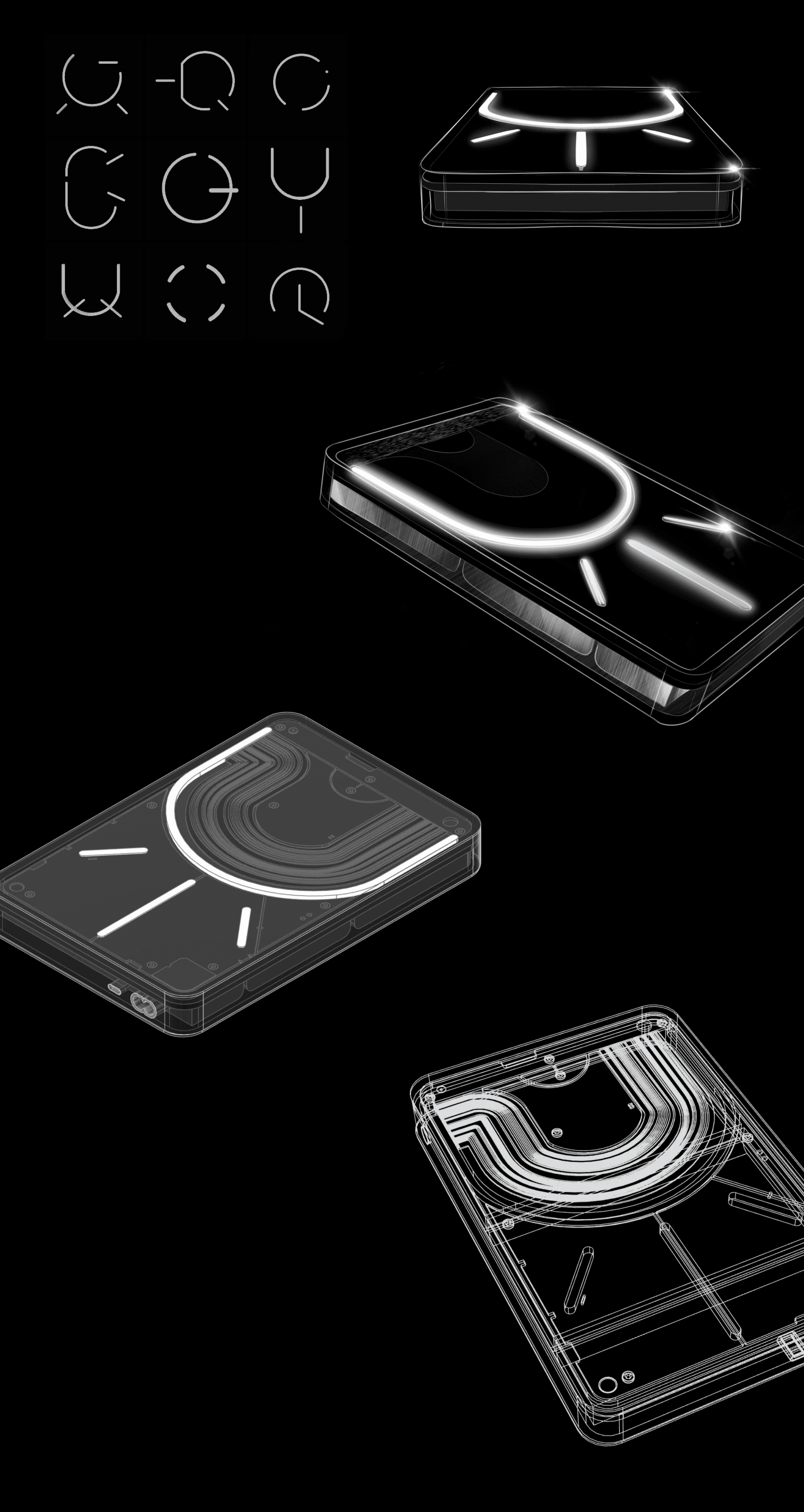
The project began by questioning why power banks feel invisible in daily use.
Phones have evolved into expressive objects, but accessories around them have not. When placed next to a Nothing phone, most power banks feel disconnected both visually and experientially.
Early sketching focused on silhouette and light placement rather than ports or internals. I explored how light could become the primary interface and how the body could be shaped around it instead of treating it as an add-on.
The goal was to design a product that could sit on a desk and feel intentionally placed, not hidden away.
User Research
The research for NOTHING Power (1) started with paying attention to small, everyday moments.
I observed how people actually use power banks. Most of the time, they are pulled out only when something goes wrong. Low battery. No socket nearby. A bit of stress. Once plugged in, the power bank is usually forgotten, thrown into a bag, or placed awkwardly on a desk with a cable running out.
When I spoke to users who regularly carry power banks, the conversations were surprisingly consistent. Nobody talked about capacity first. Instead, they spoke about uncertainty.
Is it charging properly?
How much power is left?
Did I plug it in correctly?
Do I need to check my phone again?
Almost everyone mentioned checking their phone screen repeatedly just to confirm that charging was happening. The small LED indicators on most power banks were either ignored or confusing. They worked, but they did not communicate clearly or confidently.
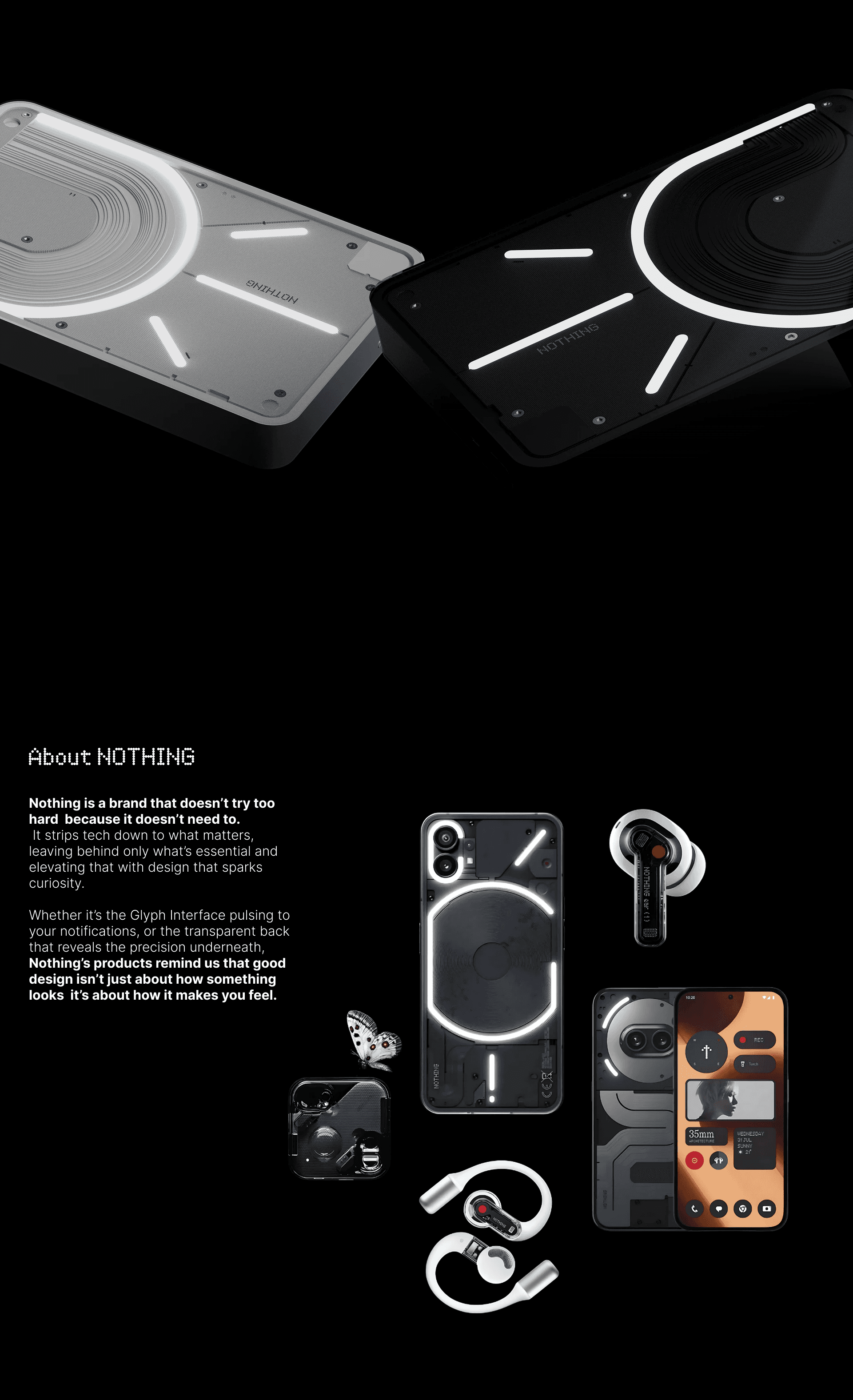
I also looked at how users interacted with Nothing phones. The Glyph system stood out immediately. People appreciated how it communicated information quietly through light, without demanding attention. It felt intentional, calm, and personal.
That contrast became important. Phones were becoming more expressive and thoughtful, while accessories remained silent and generic.
The research led to a simple but important realization.
Power banks are always present during moments of dependency, yet they offer almost no reassurance.


Approach

The approach was to design from the outside in.
Instead of starting with battery capacity or component layout, I focused on:
How the product sits in space
How light travels through the form
How the user understands state without reading numbers
The design process followed a tight loop of sketching, proportion refinement, and CAD exploration. Every surface was evaluated for how it reflects or diffuses light. Geometry was simplified repeatedly to avoid visual noise.
The power bank was treated as a product that communicates through presence, not instructions.
Solution
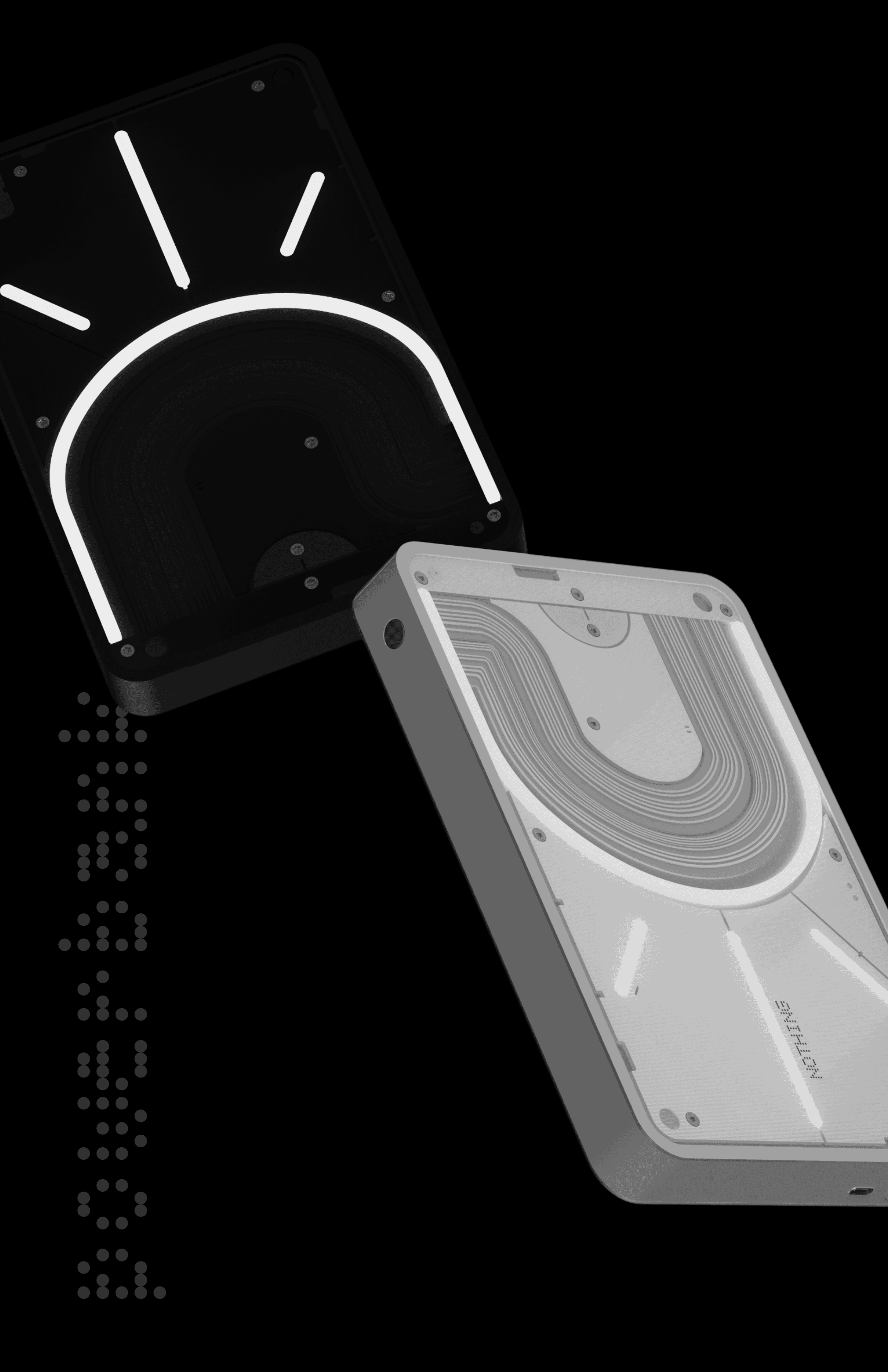
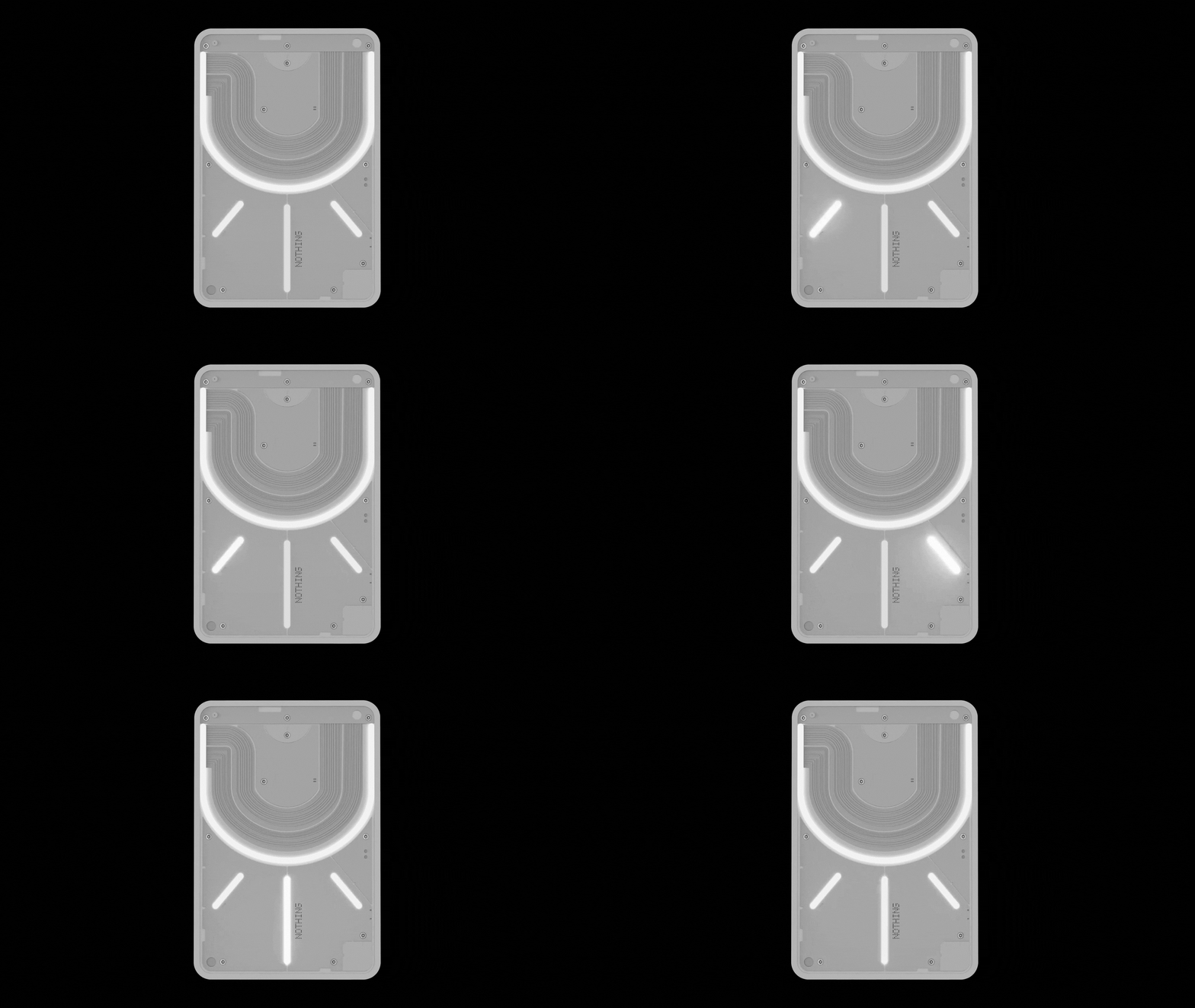
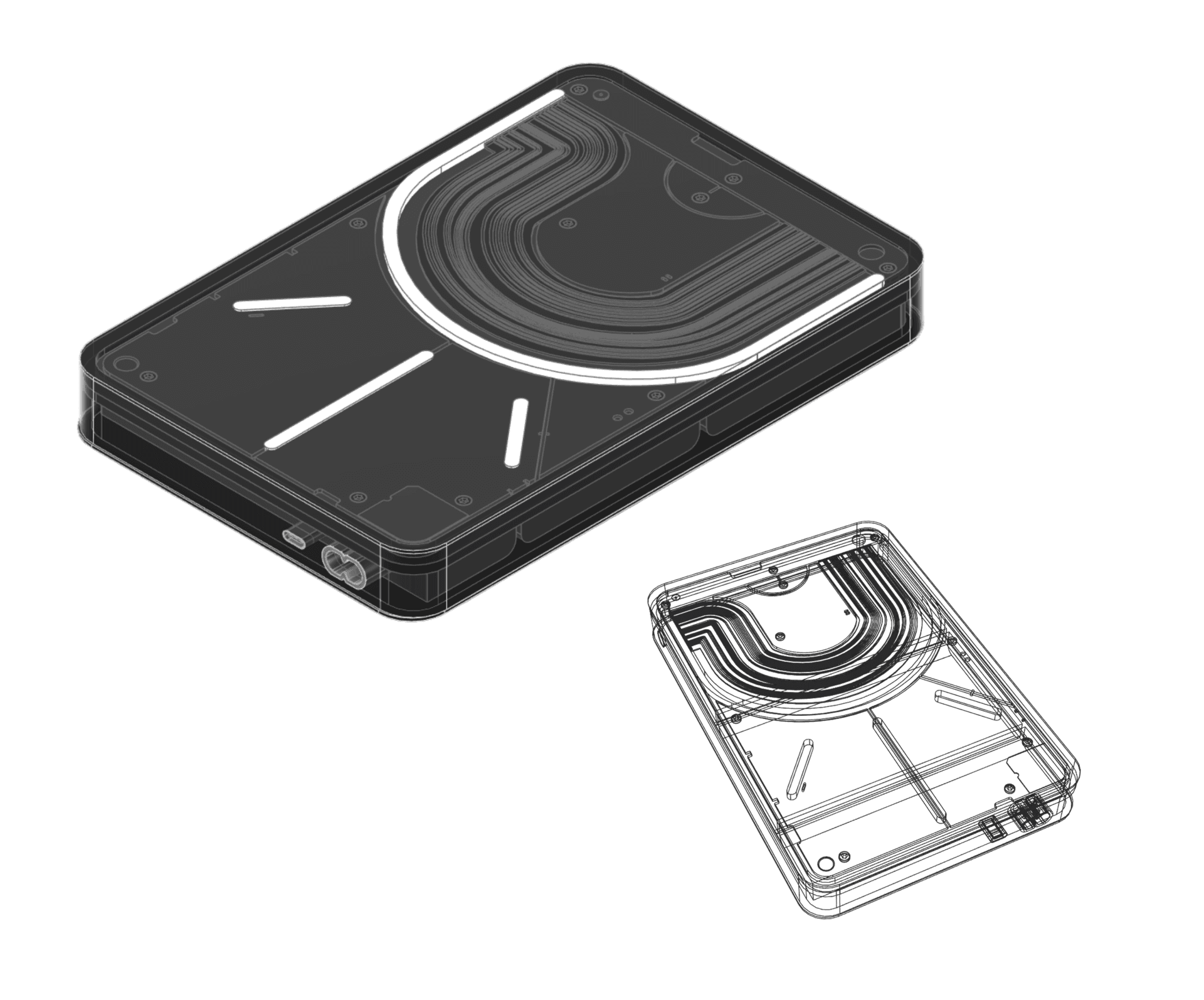
The final design features a sculpted, layered body with transparent and opaque surfaces that frame the Glyph lighting system.
When connected to a Nothing phone:
Glyph lights mirror incoming notifications
Charging progress is communicated through light patterns
Power status becomes instantly readable without screens
Ports and physical interfaces are kept minimal and cleanly integrated into the form. The object feels stable in hand and visually grounded when placed on a surface.
The power bank no longer feels passive. It participates in the interaction ecosystem.
Design Decisions
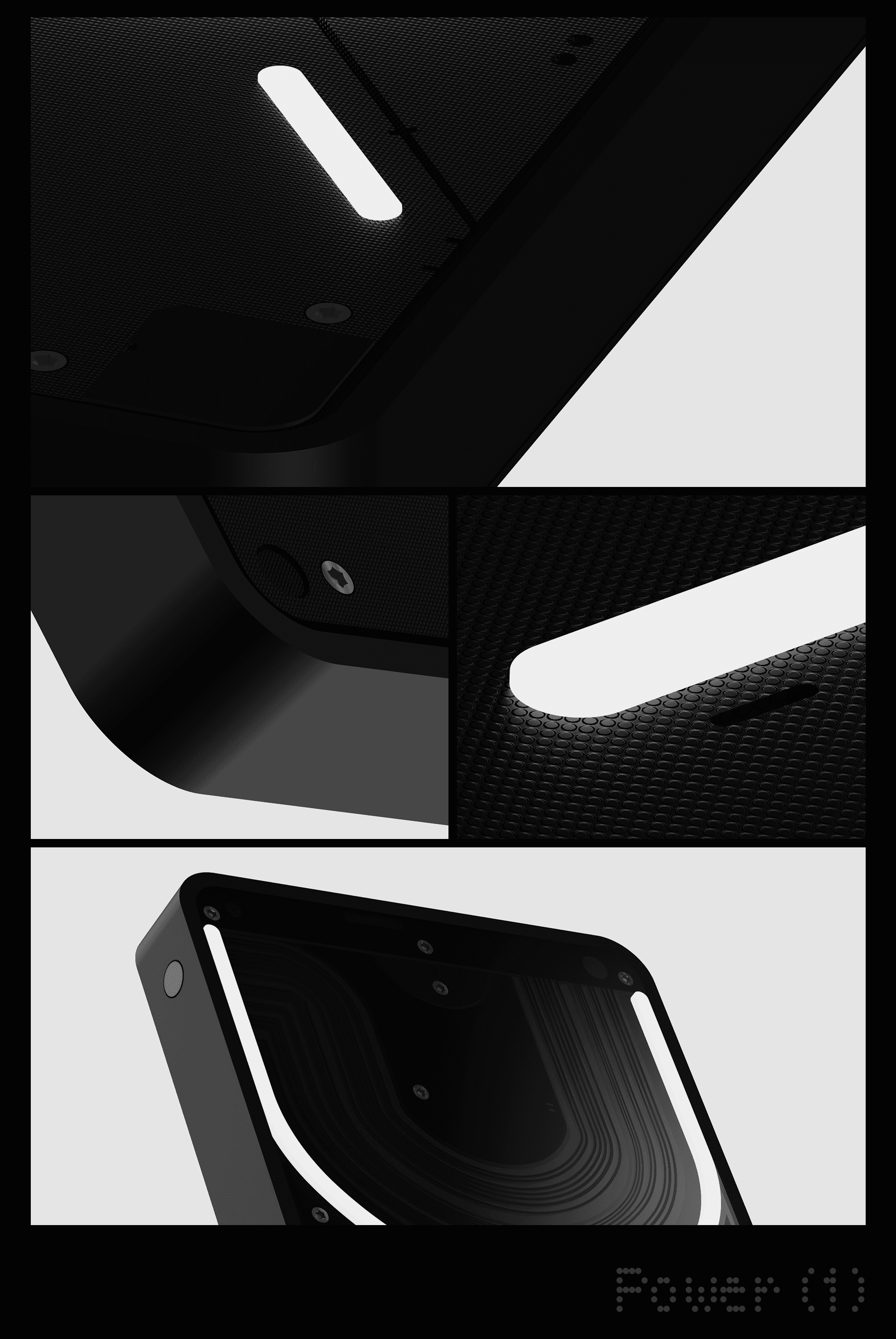
Several decisions shaped the final outcome:
Glyph as primary interface
Light replaces screens and indicators, keeping interaction subtle and distraction-free.
Transparent material strategy
Used selectively to reveal structure and allow controlled light diffusion without exposing raw internals.
Subtractive form language
Geometry is simplified to maintain focus on light and silhouette rather than surface detailing.
Brand alignment
The design intentionally mirrors Nothing’s design language so the product feels native, not inspired.
Each decision balances expression with restraint.
1.Glyph
Light replaces screens and indicators, keeping interaction subtle
2.Transparent material
Used selectively to reveal structure and allow controlled light diffusion
3.Brand alignment
The design intentionally mirrors Nothing’s design language
Key Insights
Power banks are used during moments of dependency, not convenience.
Users reach for them when their phone is about to die, which makes reassurance more important than performance numbers. In these moments, people want confirmation that things are working, not extra features.
Most users do not trust small LED indicators.
While technically functional, they fail to communicate clearly. Users still check their phones repeatedly to confirm charging, showing that existing feedback systems are not emotionally convincing.
Accessories feel disposable when they lack identity.
Users described power banks as objects they carry out of necessity, not preference. Products that visually and behaviorally align with their primary devices feel more intentional and valuable.
Light can communicate state without demanding attention.
Observing reactions to Nothing’s Glyph system revealed that users appreciate information delivered passively. Light patterns were understood intuitively and felt less intrusive than screens or notifications.
Ecosystem consistency increases confidence.
When an accessory behaves and communicates like the phone it supports, users trust it more. Consistent interaction language reduces friction and makes the product feel purpose-built rather than generic.
CAD
Renders
NOTHING POWER 1
Overview
NOTHING Power (1) is a conceptual power bank designed as an extension of the Nothing ecosystem rather than a standalone accessory.
The project explores how a highly utilitarian object can become expressive, communicative, and emotionally engaging without relying on screens or excessive controls.
By integrating Nothing’s signature Glyph lighting system, the power bank becomes an active object that mirrors notifications, charging states, and system feedback from the connected phone. The result is a product that feels alive, responsive, and visually distinct while staying minimal and purposeful.
This project focuses on form, material, light interaction, and ecosystem thinking through an industrial design lens.
Categories
Consumer Electronics
POWERBANK
Methods used
User Observation • Ergonomic Analysis • Functional Deconstruction • Form Exploration • CAD Modeling • Prototype Development
Date
Problem Statement
Power banks today are largely generic objects.
Most differ only in capacity and size, offering little thought to identity, interaction, or emotional connection.
Common issues observed:
Boxy, forgettable forms
Minimal feedback limited to small LED dots
No connection to the phone’s interaction language
Treated as accessories rather than designed products
The challenge was to redesign a power bank that feels intentional, expressive, and integrated into a larger product ecosystem while remaining realistic and functional.
Solution at a Glance
NOTHING Power (1) reimagines the power bank as a communicative object.
Instead of hiding interaction behind screens or buttons, the product uses Glyph lighting to visually convey notifications, charging status, and power information. The physical form, materials, and light diffusion are designed together to create a calm but expressive charging experience that aligns with Nothing’s brand philosophy.
How It Started
The project began by questioning why power banks feel invisible in daily use.
Phones have evolved into expressive objects, but accessories around them have not. When placed next to a Nothing phone, most power banks feel disconnected both visually and experientially.
Early sketching focused on silhouette and light placement rather than ports or internals. I explored how light could become the primary interface and how the body could be shaped around it instead of treating it as an add-on.
The goal was to design a product that could sit on a desk and feel intentionally placed, not hidden away.
User Research
The research for NOTHING Power (1) started with paying attention to small, everyday moments.
I observed how people actually use power banks. Most of the time, they are pulled out only when something goes wrong. Low battery. No socket nearby. A bit of stress. Once plugged in, the power bank is usually forgotten, thrown into a bag, or placed awkwardly on a desk with a cable running out.
When I spoke to users who regularly carry power banks, the conversations were surprisingly consistent. Nobody talked about capacity first. Instead, they spoke about uncertainty.
Is it charging properly?
How much power is left?
Did I plug it in correctly?
Do I need to check my phone again?
Almost everyone mentioned checking their phone screen repeatedly just to confirm that charging was happening. The small LED indicators on most power banks were either ignored or confusing. They worked, but they did not communicate clearly or confidently.
I also looked at how users interacted with Nothing phones. The Glyph system stood out immediately. People appreciated how it communicated information quietly through light, without demanding attention. It felt intentional, calm, and personal.
That contrast became important. Phones were becoming more expressive and thoughtful, while accessories remained silent and generic.
The research led to a simple but important realization.
Power banks are always present during moments of dependency, yet they offer almost no reassurance.
Approach
The approach was to design from the outside in.
Instead of starting with battery capacity or component layout, I focused on:
How the product sits in space
How light travels through the form
How the user understands state without reading numbers
The design process followed a tight loop of sketching, proportion refinement, and CAD exploration. Every surface was evaluated for how it reflects or diffuses light. Geometry was simplified repeatedly to avoid visual noise.
The power bank was treated as a product that communicates through presence, not instructions.
Solution
The final design features a sculpted, layered body with transparent and opaque surfaces that frame the Glyph lighting system.
When connected to a Nothing phone:
Glyph lights mirror incoming notifications
Charging progress is communicated through light patterns
Power status becomes instantly readable without screens
Ports and physical interfaces are kept minimal and cleanly integrated into the form. The object feels stable in hand and visually grounded when placed on a surface.
The power bank no longer feels passive. It participates in the interaction ecosystem.
Design Decisions
Several decisions shaped the final outcome:
Glyph as primary interface
Light replaces screens and indicators, keeping interaction subtle and distraction-free.
Transparent material strategy
Used selectively to reveal structure and allow controlled light diffusion without exposing raw internals.
Subtractive form language
Geometry is simplified to maintain focus on light and silhouette rather than surface detailing.
Brand alignment
The design intentionally mirrors Nothing’s design language so the product feels native, not inspired.
Each decision balances expression with restraint.
1.Glyph
Light replaces screens and indicators, keeping interaction subtle
2.Transparent material
Used selectively to reveal structure and allow controlled light diffusion
3.Brand alignment
The design intentionally mirrors Nothing’s design language
Key Insights
Power banks are used during moments of dependency, not convenience.
Users reach for them when their phone is about to die, which makes reassurance more important than performance numbers. In these moments, people want confirmation that things are working, not extra features.
Most users do not trust small LED indicators.
While technically functional, they fail to communicate clearly. Users still check their phones repeatedly to confirm charging, showing that existing feedback systems are not emotionally convincing.
Accessories feel disposable when they lack identity.
Users described power banks as objects they carry out of necessity, not preference. Products that visually and behaviorally align with their primary devices feel more intentional and valuable.
Light can communicate state without demanding attention.
Observing reactions to Nothing’s Glyph system revealed that users appreciate information delivered passively. Light patterns were understood intuitively and felt less intrusive than screens or notifications.
Ecosystem consistency increases confidence.
When an accessory behaves and communicates like the phone it supports, users trust it more. Consistent interaction language reduces friction and makes the product feel purpose-built rather than generic.
CAD
Renders
NOTHING POWER 1
Overview
NOTHING Power (1) is a conceptual power bank designed as an extension of the Nothing ecosystem rather than a standalone accessory.
The project explores how a highly utilitarian object can become expressive, communicative, and emotionally engaging without relying on screens or excessive controls.
By integrating Nothing’s signature Glyph lighting system, the power bank becomes an active object that mirrors notifications, charging states, and system feedback from the connected phone. The result is a product that feels alive, responsive, and visually distinct while staying minimal and purposeful.
This project focuses on form, material, light interaction, and ecosystem thinking through an industrial design lens.
Categories
Consumer Electronics
POWERBANK
Methods used
User Observation • Ergonomic Analysis • Functional Deconstruction • Form Exploration • CAD Modeling • Prototype Development
Date
Problem Statement
Power banks today are largely generic objects.
Most differ only in capacity and size, offering little thought to identity, interaction, or emotional connection.
Common issues observed:
Boxy, forgettable forms
Minimal feedback limited to small LED dots
No connection to the phone’s interaction language
Treated as accessories rather than designed products
The challenge was to redesign a power bank that feels intentional, expressive, and integrated into a larger product ecosystem while remaining realistic and functional.
Solution at a Glance
NOTHING Power (1) reimagines the power bank as a communicative object.
Instead of hiding interaction behind screens or buttons, the product uses Glyph lighting to visually convey notifications, charging status, and power information. The physical form, materials, and light diffusion are designed together to create a calm but expressive charging experience that aligns with Nothing’s brand philosophy.
How It Started
The project began by questioning why power banks feel invisible in daily use.
Phones have evolved into expressive objects, but accessories around them have not. When placed next to a Nothing phone, most power banks feel disconnected both visually and experientially.
Early sketching focused on silhouette and light placement rather than ports or internals. I explored how light could become the primary interface and how the body could be shaped around it instead of treating it as an add-on.
The goal was to design a product that could sit on a desk and feel intentionally placed, not hidden away.
User Research
The research for NOTHING Power (1) started with paying attention to small, everyday moments.
I observed how people actually use power banks. Most of the time, they are pulled out only when something goes wrong. Low battery. No socket nearby. A bit of stress. Once plugged in, the power bank is usually forgotten, thrown into a bag, or placed awkwardly on a desk with a cable running out.
When I spoke to users who regularly carry power banks, the conversations were surprisingly consistent. Nobody talked about capacity first. Instead, they spoke about uncertainty.
Is it charging properly?
How much power is left?
Did I plug it in correctly?
Do I need to check my phone again?
Almost everyone mentioned checking their phone screen repeatedly just to confirm that charging was happening. The small LED indicators on most power banks were either ignored or confusing. They worked, but they did not communicate clearly or confidently.
I also looked at how users interacted with Nothing phones. The Glyph system stood out immediately. People appreciated how it communicated information quietly through light, without demanding attention. It felt intentional, calm, and personal.
That contrast became important. Phones were becoming more expressive and thoughtful, while accessories remained silent and generic.
The research led to a simple but important realization.
Power banks are always present during moments of dependency, yet they offer almost no reassurance.
Approach
The approach was to design from the outside in.
Instead of starting with battery capacity or component layout, I focused on:
How the product sits in space
How light travels through the form
How the user understands state without reading numbers
The design process followed a tight loop of sketching, proportion refinement, and CAD exploration. Every surface was evaluated for how it reflects or diffuses light. Geometry was simplified repeatedly to avoid visual noise.
The power bank was treated as a product that communicates through presence, not instructions.
Solution
The final design features a sculpted, layered body with transparent and opaque surfaces that frame the Glyph lighting system.
When connected to a Nothing phone:
Glyph lights mirror incoming notifications
Charging progress is communicated through light patterns
Power status becomes instantly readable without screens
Ports and physical interfaces are kept minimal and cleanly integrated into the form. The object feels stable in hand and visually grounded when placed on a surface.
The power bank no longer feels passive. It participates in the interaction ecosystem.
Design Decisions
Several decisions shaped the final outcome:
Glyph as primary interface
Light replaces screens and indicators, keeping interaction subtle and distraction-free.
Transparent material strategy
Used selectively to reveal structure and allow controlled light diffusion without exposing raw internals.
Subtractive form language
Geometry is simplified to maintain focus on light and silhouette rather than surface detailing.
Brand alignment
The design intentionally mirrors Nothing’s design language so the product feels native, not inspired.
Each decision balances expression with restraint.
1.Glyph
Light replaces screens and indicators, keeping interaction subtle
2.Transparent material
Used selectively to reveal structure and allow controlled light diffusion
3.Brand alignment
The design intentionally mirrors Nothing’s design language
Key Insights
Power banks are used during moments of dependency, not convenience.
Users reach for them when their phone is about to die, which makes reassurance more important than performance numbers. In these moments, people want confirmation that things are working, not extra features.
Most users do not trust small LED indicators.
While technically functional, they fail to communicate clearly. Users still check their phones repeatedly to confirm charging, showing that existing feedback systems are not emotionally convincing.
Accessories feel disposable when they lack identity.
Users described power banks as objects they carry out of necessity, not preference. Products that visually and behaviorally align with their primary devices feel more intentional and valuable.
Light can communicate state without demanding attention.
Observing reactions to Nothing’s Glyph system revealed that users appreciate information delivered passively. Light patterns were understood intuitively and felt less intrusive than screens or notifications.
Ecosystem consistency increases confidence.
When an accessory behaves and communicates like the phone it supports, users trust it more. Consistent interaction language reduces friction and makes the product feel purpose-built rather than generic.
CAD
Renders